

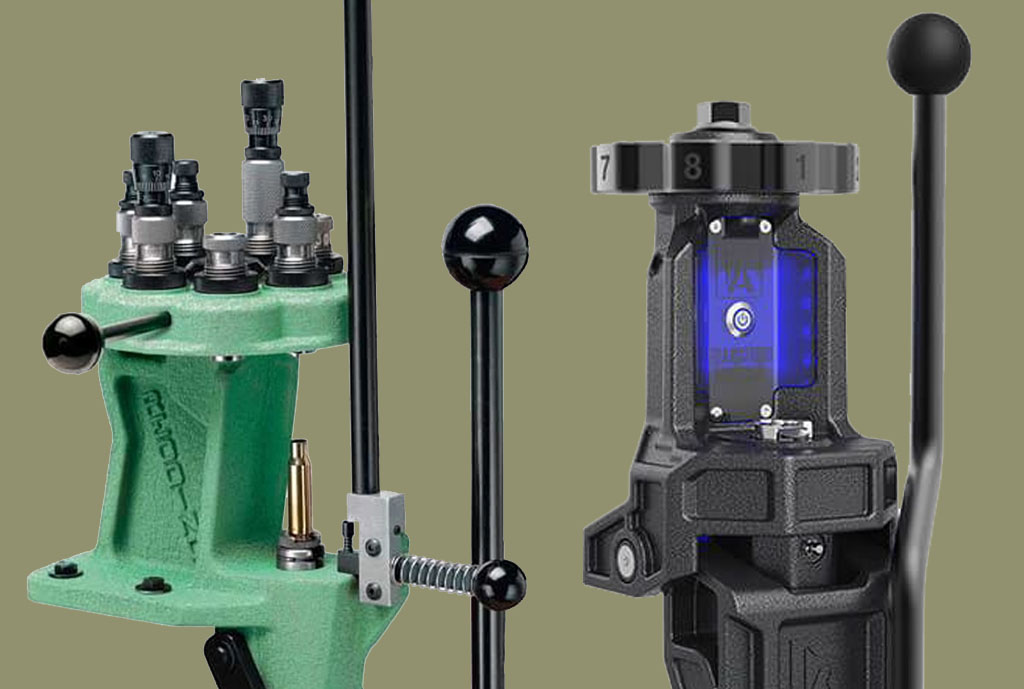
Correctly setting up your dies is crucial for accurate ammunition. In this article, you'll learn how to approach this and why a turret press significantly simplifies your work.
The Basics of Die Setup
Every reloader knows the ritual: you've bought new dies, want to switch calibers, or are just starting out with reloading. Then comes the moment when you need to correctly set up your sizing die, seating die, and possibly crimp die. This process demands precision and patience, because an incorrectly adjusted die directly results in inconsistent ammunition or even unsafe situations.
With a standard single-stage press, you remove the die after each operation and screw in the next one. This means you have to readjust, measure, and fine-tune with every loading session. Especially for precision reloaders working with things like bullet seating depth to the hundredth of a millimeter, this is a time-consuming and error-prone activity.
What Makes a Turret Press Different?
A turret press elegantly solves this problem. Instead of one die position, you have a rotating head (turret) with multiple positions, usually four to seven. You install all your dies for one caliber in the turret and set them up perfectly once. After that, you simply rotate the turret to the next position for the next operation.
The big advantage? Your dies stay exactly in place. The sizing die you've adjusted to the tenth of a millimeter for your 6mm BR Norma stays precisely where it is, even after hundreds of loading rounds. No hassle with lock rings that shift just slightly, no re-measuring your bullet seating depth.
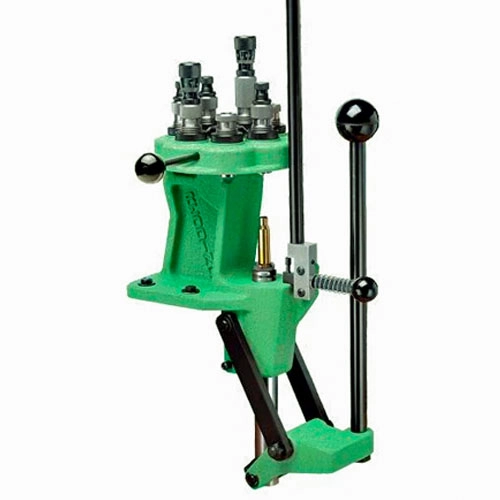
The Redding T-7 Turret Press offers seven die positions for complete control over your reloading process.
Step by Step: Setting Up Dies on a Turret Press
Setting Up the Sizing Die
Start with the sizing die in position one. Hand-thread the die into the turret until it touches the shellholder when the ram is fully raised. Then turn another quarter turn for full-length sizing, or set the die higher if you prefer neck sizing.
For precision reloading for F-Class or benchrest, you often want minimal resizing. Measure the shoulder setback with a headspace gauge and adjust the die height until you achieve exactly the desired setback, often between 0.001" and 0.002". On a turret press, you set this once and maintain this setting for all future loading sessions with this caliber.
Setting Up the Seating Die
The bullet seating die requires the most attention in precision reloading. Start by threading the die into the turret without it touching the case. Place a sized case with bullet in the shellholder and turn the seating stem down until it just touches the bullet.
Now load your first test cartridge and measure the COAL (Cartridge Overall Length) or even better, the CBTO (Cartridge Base To Ogive). Adjust the seating stem until you reach the desired depth. For many precision calibers like 6mm BR or 6.5 Creedmoor, you work with specific distances to the lands, often between 0.010" and 0.020" jump.
Found the perfect seating depth? Then this setting remains preserved in your turret. At your next loading session, simply rotate to the correct position and get started immediately.
Crimp Die (Optional)
For semi-automatic rifles or lever actions, a separate crimp die may be necessary. Install this in the next turret position and adjust the crimp so it provides just enough tension without damaging the case.
Advantages of a Turret Press for Precision Reloaders
Consistency Between Loading Sessions
The biggest gain is in reproducibility. Precision shooters know that small variations in bullet seating depth are directly visible at the range. A difference of just 0.005" can make the difference between a tight group and a disappointing result.
With a turret press, you eliminate the variable of readjustment. Your dies stay where they need to be, session after session.
Speed Without Compromises
While a progressive press produces faster, it often sacrifices precision. A turret press offers a middle ground: you work more efficiently than with a single-stage, but maintain full control over every step of the process. For reloaders producing 50 to 200 cartridges per session, this is often the sweet spot.
Multiple Calibers, Multiple Turrets
Do you shoot multiple calibers? Buy extra turrets and set them up once for each caliber. Switching between your 6mm BR match loads and your .308 Win hunting ammunition then takes only seconds: turret out, other turret in, done.

The Frankford Arsenal Precision Turret Press offers excellent value for reloaders seeking turret convenience.
Practical Tips for Optimal Die Usage
Secure lock rings properly
Use lock rings with a set screw or choose the cross-bolt variant that cannot work loose. A shifted lock ring means a changed setting.
Document your settings
Note the exact die settings for each caliber: number of turns from the base, seating depth, shellholder used. Should you ever need to reset, you have a starting point.
Clean regularly
Residue in the sizing die affects the dimensions of your cases. Clean your dies after each loading session or after a maximum of 200 cases.
Check your first cartridges
Always measure the first five cartridges of a new loading session. Even with a turret press, a lock ring can come loose or the turret indexing can deviate.
Which Turret Press Suits You?
The choice depends on your budget and ambition level. The Redding T-7 is considered the industry standard for serious precision reloaders. With seven die positions and legendary Redding build quality, this is an investment for life. The powerful compound leverage makes resizing even magnum cases effortless.
For reloaders looking for an affordable entry into the turret world, the Frankford Arsenal Precision Turret Press offers excellent value for money. The solid design and smooth operation make this a popular choice for both beginners and experienced reloaders wanting a second press.
Conclusion
Setting up dies requires precision and attention. A turret press eliminates much of the frustration by preserving your settings between sessions. For precision reloaders who want to produce consistent ammunition without having to fine-tune every time, a turret press is not a luxury but a logical choice.
Whether you're working on match-grade 6mm BR cartridges for benchrest, or loading reliable hunting ammunition for the season, with a turret press you work more efficiently and accurately. The time investment during initial setup pays off double with every subsequent loading session.
Browse our complete range of reloading presses and reloading equipment for everything you need for precision reloading.