
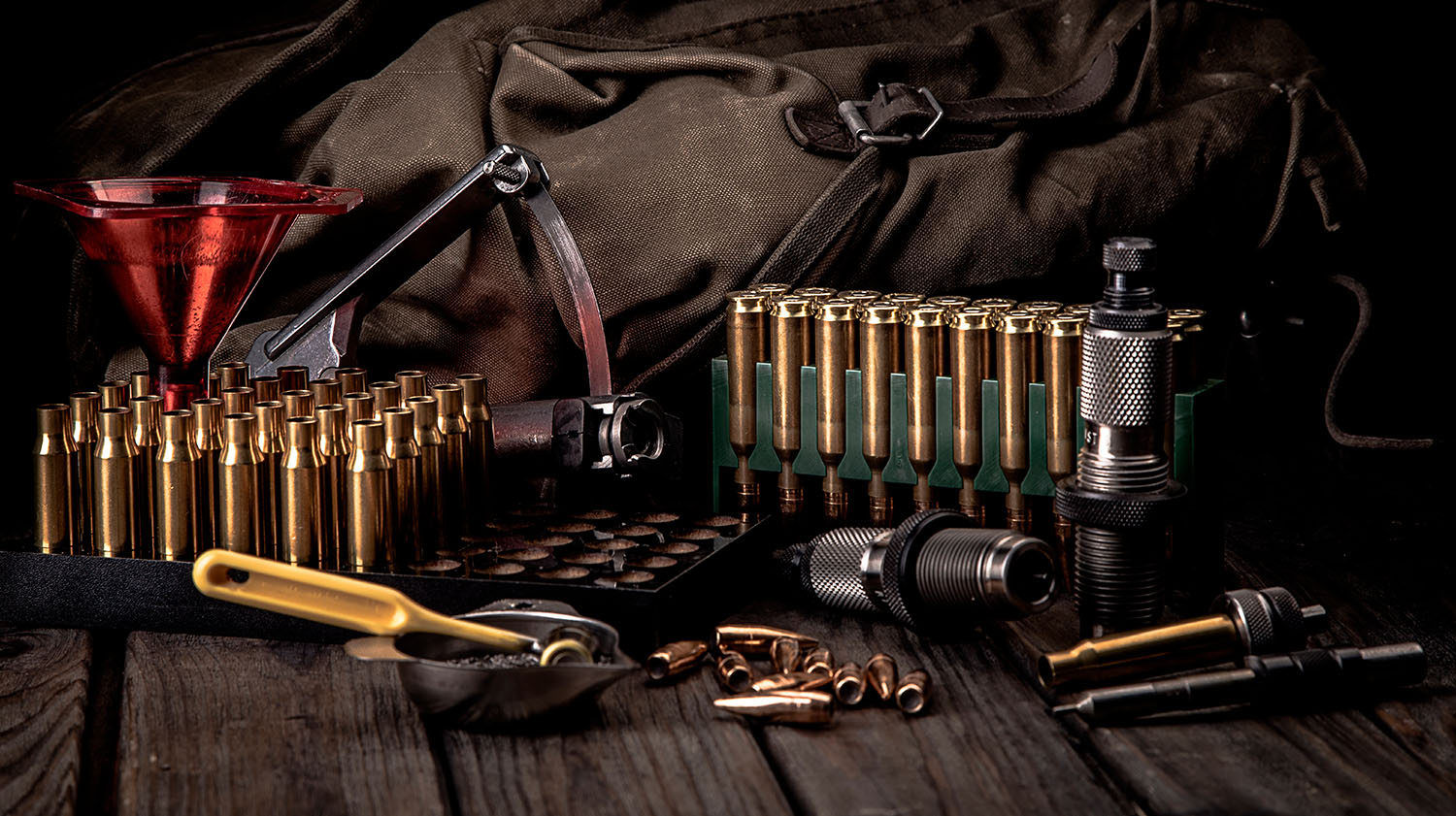
It takes some figuring out what all you need if you want to start reloading ammo. In this article we list everything for you and maybe you will get a better overview.
Reloading press
A reloading press is the base on your worktable for reloading ammunition, in several steps in reloading you are going to use it. A good start is to choose a single-station press. This type of tool offers accurate alignment of the dies (Dies) and the shellholders (shellholders) because the die station hole and the ram hole of the shellholder are aligned. Such tools last a lifetime. Cheaper reloading tools are available for the shooter with a limited budget up to two thousand dollar reloading presses.
Shell Holder
The shellholder (sleeve holder) allows the shell to be stably aligned in the various dies/Dies and pushed in and pulled out. One shell holder can serve for several cartridges, it depends on the footprint/boltface of the shell. For example, a sleeve holder for 30-06 is also suitable for calibers 22-250, 243, 25-06, 270, 308 and many others. Be sure to use the correct sleeve holder, otherwise the sleeve edge may tear off during resizing. This causes the sleeve to jam in the die, a very difficult situation to correct, however, with the Stuck Case Remover from RCBS this is a piece of cake. Use shellholder tables to make sure you have the right shellholders on your workbench. A must for anyone who wants to reload their own ammunition, without shellholders you can't do anything.
We will tell you more about them in the following article: Shellholder table
Still not sure which shellholder you need? Then contact our customer service team, we will be happy to help you!
Die set - Die dies
A die set can consist of two, three or four separate dies. The first die is a resizing die designed to return the fired and expanded sleeve to the factory dimensions, or where you want it. This die usually also removes the fired detonator. Without the proper reset, fired shells can fail in the chamber. For beginners, we recommend purchasing a complete die set. Most die sets are caliber-specific.
The bullet setting die (seater Die) places the bullet at the correct depth (adjustable). If necessary, it can also shrink sleeves on bullets. A crimp is necessary for ammunition used in most revolvers and in pistols with tubular magazines. Ammunition for use in pump or semi-automatic rifles is also normally crimped. Some shooters find crimping more accurate if done separately from placing the bullet. Therefore, an additional die is sometimes used. Most seating dies with crimp and shrink dies use a roller crimp.
WARNING: Never attempt to adjust the size of a loaded sleeve.
Case lube.
In all reloading operations (except when using a carbide die for straight-walled handgun cartridges), casings must be lubricated before resizing. Failure to do so will cause the sleeve to jam hopelessly in the die.
The proper method for applying lube is to use a lubricating pad to apply the lube to your cartridges. As an alternative to using a pad, you can use a spray-on type of lubricant, such as the Lyman's Quick Slick Case Lube or the IOSSO Sizing Lube which is ranked #1 worldwide.
Primer seater
A primer seater allows the percussion cap to be placed in the ferrule. Opinions are divided on it and there are several options.
- Hand primer seater: Many top shooters do it by feel with a hand primer seater, pressing the primer (by feel) into the ferrule up to the stop.
- Benchtop primer seater: It can also be done by feel with a benchtop, however, it is less compact.
- For both hand primers and benchtop primer seaters, there are also precision primer seaters with even a micrometer. For an ultra precision hand primer, we have the micrometer hand primer from K&M precision.
- If you want extreme precision and set primers on your reloading press, Derraco Engineering has invented this for you. The PCPS Precision primer seater from Derraco.. This primer seater has a 7/8-14 thread and can be threaded into your reloading press just like other Dies. The shellholder is replaced with an imager and is also included with the PCPS. A Lee footprint shellholder is inserted into the PCPS, which you need to order separately.
Primer tray
A primer (turning) tray is used to orient all primers with one side up so that they are correctly oriented when picked up and placed in the primer tube. It also helps keep primers free of contaminants.
Reload scale
To ensure that the exact amount of powder is placed in each shell, each powder charge must be carefully weighed.
Powder tricker
These ensure quick and accurate work. The tricker adds powder, one grain at a time, to the scale to bring a propellant charge to its exact weight.
Funnel - powder funnel
Without a powder funnel, there is no practical way to get the powder from the shell into the casing. A simple but effective funnel works with shells from 22 caliber to 45 caliber. The Powder Funnel from Lyman is a great reloading tool for pouring powder into a shell without spilling.
Reloading block
Loading blocks keep cartridges organized on the workbench. Always use two loading blocks. One loading step is performed and then they are placed in the second loading block (on the other side of the loading tool).
Slider
This tool allows the reloader to accurately measure the depth of the inserted percussion caps, check the sleeve length before and after trimming, maintain the correct overall length of the cartridge, measure the resizing of the sleeve and detect any source of trouble. Slide gauges are available as inexpensive plastic types or as stainless steel models that sometimes last longer than the reloader.
Bullet comparator set
The Ugly Headspace and Bullet Comparator Set from Derraco is an indispensable tool for any serious reloader. This set provides an accurate and reliable way to measure the headspace and setting depth of your ammunition, improving consistency and accuracy in your shots. Some other brands and, for example, the Hornady headspace comparators are not precise enough to measure to the thousandth of an accuracy. This also makes it difficult to accurately measure shoulder bumb. From our own experience, experiences of fellow shooters and from our customers, we can guarantee that Ugly's products are many times more solid.
Case trimmer
Cartridges stretch when they are fired. Cartridges are often shortened when resizing, but their necks tend to stretch during this process. After one firing and resizing, a shell casing can stretch beyond the point that it is still suitable for reloading. Under some circumstances, a shell can be reloaded and fired four or five times before the length exceeds the maximum size allowed. In any case, there will always be a point at which you must trim the shell to a workable size before it can be reloaded.
Trimmers require the use of a pilot of the proper caliber to keep the shells positively aligned during the trimming process. Some sleeve trimmers require the use of an appropriate sleeve holder. A precise sleeve length is crucial for accuracy and smooth, reliable operation. Lyman has the widest selection of trimmers for reloading.
Ugly SRT Case Trimmer - Derraco
Frankford Arsenal Platinum Trimmer Station
Cleaning of fired shells.
A dull-looking sleeve is of no concern. However, a dirty sleeve can reduce the quality of reloading and cause a defect to go undetected or scratch the reloading dies and/or chambers, requiring premature replacement of the die or even your firearm.
Cartridges can be cleaned in a number of ways. Polishing drums, both vibrating drums and rotary drums, can make some casings look like new again. Polishing drums are available for almost any application, both in terms of the amount of sleeves to be processed and the cost. Ultrasonic cleaners also do a great job cleaning both the sleeves and the inside of the sleeve.