
Last checked on 6 October 2026 against the Dutch Weapons and Ammunition Act, the Customs handbook and the consent application form dated 1 October 2026.
The rifle you want is sitting at a dealer in Germany. Or you are looking at a barrel, or a complete build, from the United States. Can you bring it in as a Dutch licence holder? Yes, but only with a consent: the permit Dutch Customs issues for firearms and ammunition entering or leaving the country.
This article covers what a consent is, the order in which to arrange things, how to complete the form and what changes depending on where the firearm comes from.
The short version
Category II and III firearms and ammunition may not enter or leave the Netherlands without a consent (Article 14 of the Act)
Consents are issued by Dutch Customs, through its Central Import and Export Office (CDIU)
First have the firearm added to your licence with a WM3, then apply for the consent
A consent covers one shipment and travels with the firearm
The application form was updated on 1 October 2026, always use the current version
What is a consent?
Article 14(1) of the Weapons and Ammunition Act prohibits bringing category II and III firearms or ammunition into or out of the Netherlands without a consent. Article 16 assigns the issuing to Customs, specifically the CDIU. So not the police, even though your licence itself runs through them.
There are four types:
Entry, for a firearm you buy abroad
Exit, for a firearm leaving the country, for instance when you sell to a foreign shooter
Exit followed by entry, for temporary export such as a repair abroad
Entry followed by exit, for transit
The Act adds a few conditions. The consent must accompany the firearm to its destination, the firearm must be packed so it cannot be used straight away, and the rules apply to online and distance sales as well.
Consent and "prior consent"
The EU Firearms Directive and many foreign dealers talk about prior consent. When you buy within the EU, the seller's country wants proof that the Netherlands agrees to the transfer. The Dutch consent for entry is that proof.
Licence first, consent second
Article 20 of the Act states that a consent for entry is refused if you are not allowed to possess the firearm in the Netherlands. That fixes the order. You first have the firearm added to your licence with a WM3, listing the foreign seller in section 5, and only then apply for the consent.
Our article on forms WM3 and WM32 explains the WM3. No licence yet? Start with the route to a Dutch firearms licence.
Step by step: buying within the EU
Collect all the details. Make, model, calibre and serial number of the firearm, plus the seller's details and a copy of their ID or company details. An invoice or option slip helps.
Have the firearm added to your licence. Through a WM3 at the licensing team, signed by your club.
Apply for the consent with the CDIU. Choose entry in question 1 and attach the required documents.
Send a copy to the seller. The seller uses it to apply for a transfer licence in their own country, usually together with a copy of your ID and licence.
Have the firearm shipped or collect it. The consent travels with it to the destination.
Present the firearm to the police. Just as with a Dutch purchase, within the period set by the licensing team.
Return the consent. Follow the instructions printed on the consent. Usually you complete the reverse and return it to Customs after use, or unused if the shipment does not go ahead.
Buying in Germany
In Germany the seller arranges the Erlaubnis zum Verbringen under section 31 of the Waffengesetz. It is only granted once the destination country's prior consent is in place, which in your case is the Dutch consent. German dealers holding a multi-year general permit are often quicker, because they only have to notify each transfer.
Buying in Belgium
This depends on the region where the seller lives or trades. At federal level and in Wallonia the seller applies for a transfer licence, while Flanders has an exemption for transfers to the Netherlands and Luxembourg. On the Dutch side the consent is always required. Let the seller work out what is needed on their end.
Buying outside the EU
For a firearm from the United States, Switzerland or the United Kingdom you use the same consent form, with entry as the type of application. The difference lies in the customs formalities at the border:
The import is declared for free circulation, quoting your consent number
Type, make, model, serial number and quantity must match the consent exactly, no more and no less
You pay import duty and 21% Dutch VAT on the value including shipping
The seller also needs an export licence from their own country:
United States: the exporter applies for an export licence. Under the revised US rules of 30 September 2025, firearms and ammunition going to the EU generally require one. Work with an exporter who regularly ships to Europe.
Switzerland: the Swiss federal police (fedpol) issue an accompanying document for exports to a Schengen country.
United Kingdom: the seller needs a UK export licence, which requires proof of import approval from the Netherlands. Your consent serves that purpose.
If a foreign exporter asks for an import certificate or end user statement, check with the CDIU beforehand which document they issue for that.
From 12 February 2029, new EU rules on the import, export and transit of firearms apply (Regulation (EU) 2025/41), with harmonised licences and an electronic system. Until then, the procedure described here stands.
Parts, ammunition and reloading components
Consent is not only for complete firearms. Dutch law treats essential components like the firearm itself, and the same principle applies to ammunition and its components.
Item | What you need |
|---|---|
Complete firearm | Registration on your licence and a consent for entry |
Essential components such as a barrel, bolt or breech block | Same category as the firearm, so a consent as well. Practice around barrel blanks is not uniform, ask the CDIU in advance |
Ammunition | Consent |
Bullets, cases and primers | Treated as ammunition components under the circular, so consent is required in principle. Agree larger shipments with the CDIU beforehand |
Gunpowder | Not covered by the firearms act but by the Civil Explosives Act, see the transfer licence |
Suppressor | Category I, prohibited unless the minister grants an exemption (through Justis). A consent is not the route here |
Completing the consent form
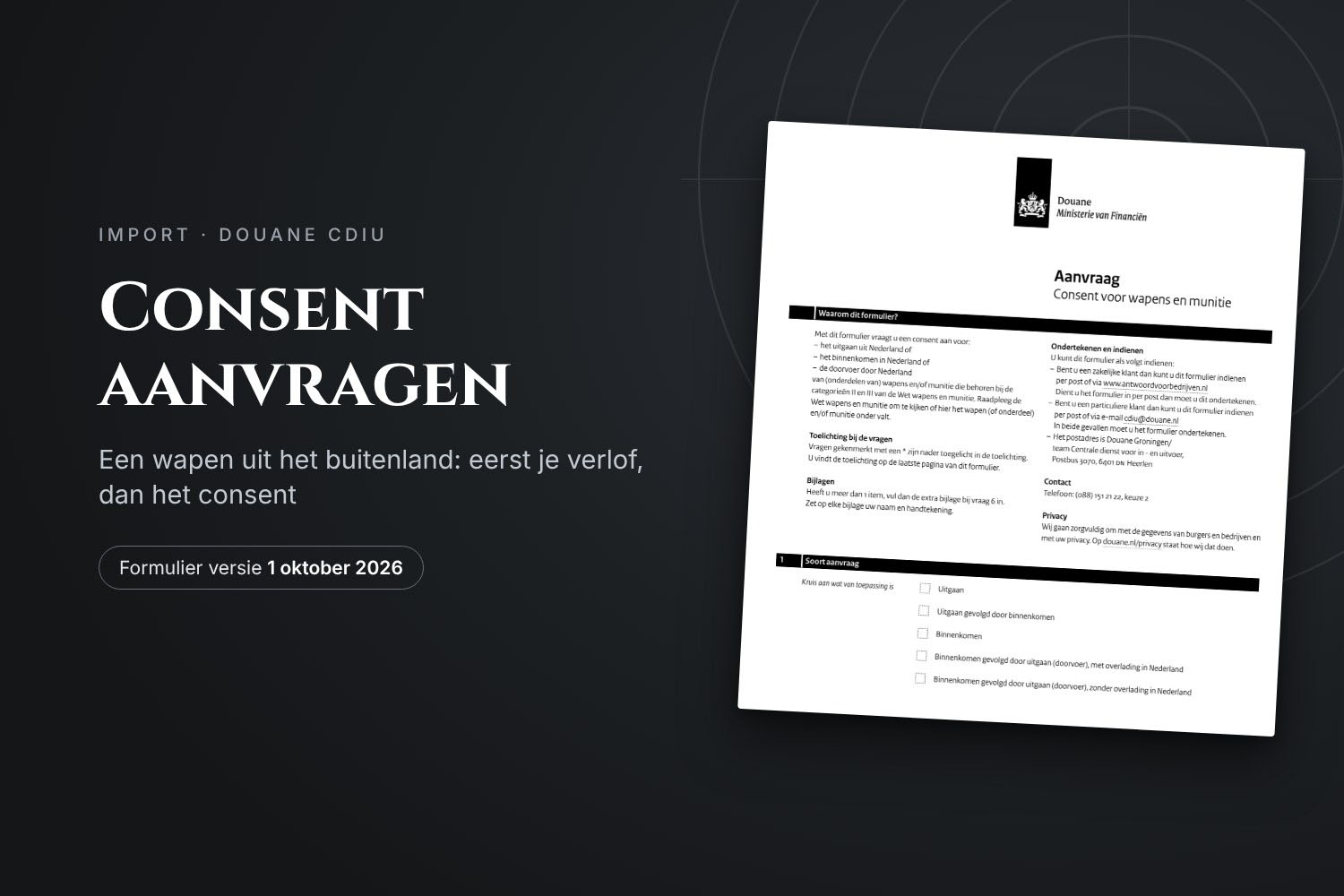
The CDIU uses one form for every type of consent. A new version went online on 1 October 2026, so do not reuse a copy you saved earlier. There is an English version too, useful for showing a foreign seller.
Question | What goes in |
|---|---|
1. Type of application | For a purchase abroad: entry |
2. Countries | Country of dispatch and of destination, and whether it applies vice versa |
3. Applicant | As a private person your BSN, name, address and contact details, whether you are a dealer (no), your ID and the legal basis: your licence number and expiry date |
4. Consignor | The foreign seller's details, in the same structure |
5. Consignee | Who receives the firearm, usually you |
6. Firearms and ammunition | Quantity, type (or component), make, model, calibre, serial number, whether it was proofed in a C.I.P. country, EU category (A, B or C) and net weight. More than one item? Use the annex |
7. Shipment | Carrier, mode of transport, departure and expected arrival date and any transit countries |
8. Signature | Name, place, date, signature and number of attachments |
Attachments and submitting
A copy of your ID
A full copy of your licence, including the annex listing your firearms
A copy of the consignor's ID or company details
Private applicants send the signed form to the CDIU by email or post. Businesses submit through the Dutch business message box.
Download consent form (pdf, English)Annex for multiple itemsDutch version
Source: douane.nl, consent application for weapons and ammunition. If a download link stops working, check that page for the latest version.
Contacting the CDIU
Dutch Customs, Central Import and Export Office (CDIU)
Postbus 3070, 6401 DN Heerlen, the Netherlands
Phone +31 88 151 21 22, option 2 for consents
Email for private applicants: cdiu@douane.nl
Costs and processing time
Customs does not publish a fixed fee or processing time for consents. In practice it can take several weeks, with reports of up to around six. Add the time the seller needs for their own paperwork.
So plan well ahead, especially if you need the firearm for a particular match. And note that Dutch law does not grant this consent by default if Customs fails to decide in time: no decision means no consent.
Importing yourself or through a dealer?
As a private licence holder you may apply for a consent and import yourself, the form is designed for that. You do not need a licensed dealer.
A dealer can still make life easier. They know the procedure, deal with foreign suppliers regularly and can take a lot of the legwork out of a complicated shipment or an order from the United States.
Frequently asked questions
Do I need a consent to take my own rifle to a match abroad?
Usually not. For that you use the European Firearms Pass and an invitation from the organising club. Our article on the transfer licence covers it.
I am selling a firearm to a shooter in Germany. What do I need?
A consent for exit from the CDIU. It is only granted if you show that Germany has no objection to the transfer, for example with the buyer's German approval. Afterwards you have the firearm removed from your licence.
How long is a consent valid?
A consent covers one shipment. If the shipment does not happen, return it unused.
Further reading
Official sources (mostly in Dutch): Weapons and Ammunition Act (Articles 14 to 20), douane.nl: consent application, Justis: consent or export licence and the Customs handbook on weapons and ammunition. This article is not legal advice. If you are unsure about a specific shipment, contact the CDIU before you buy.