

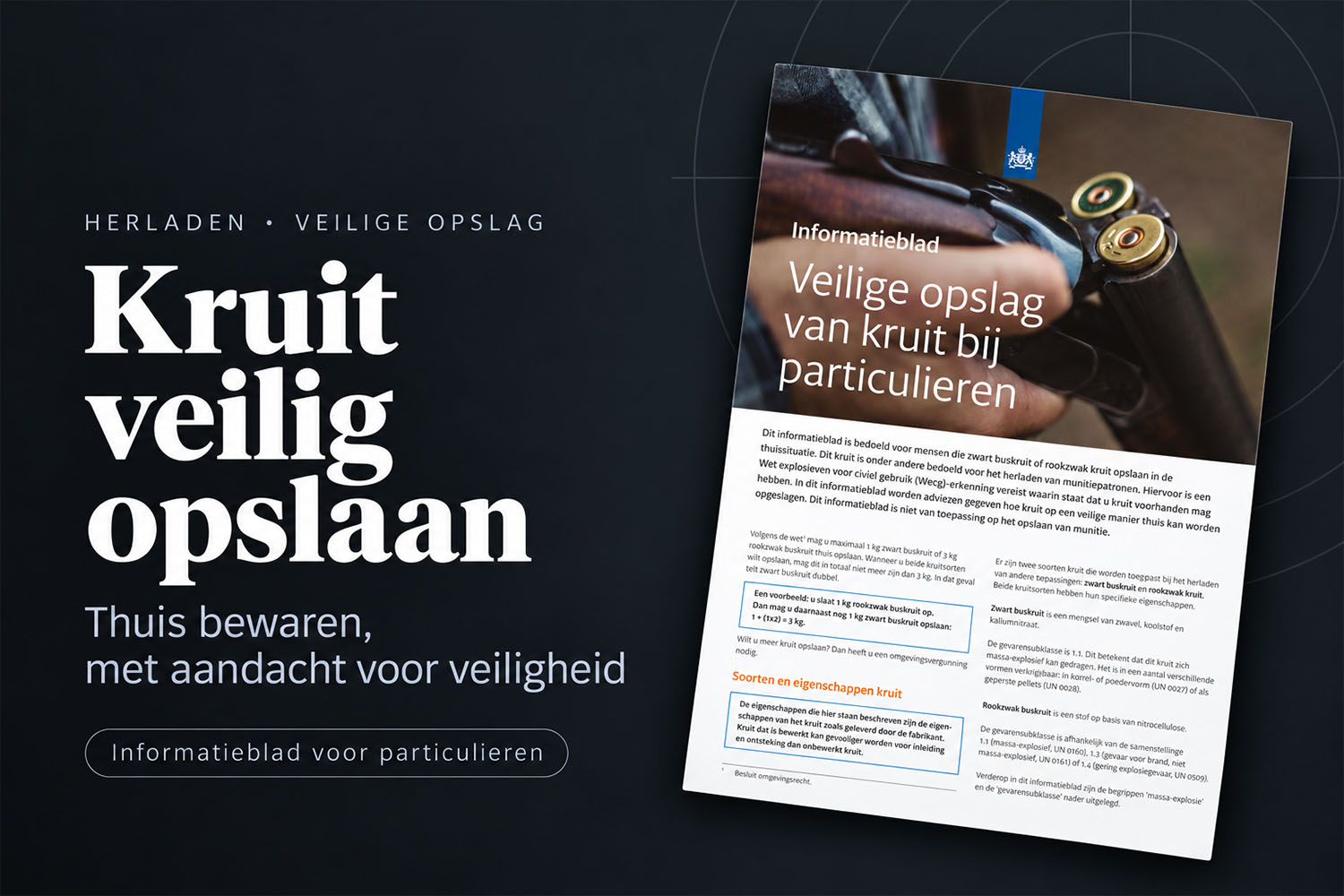
Last checked on 7 October 2026 against the Dutch information sheet on safe storage of gunpowder by private individuals (published by the Dutch government with RIVM, ILT, KNSA, KNJV, KNTS and the National Police) and current guidance from the Dutch Environment and Planning Information Point.
If you reload, you keep powder at home. Most reloaders instinctively reach for the gun safe. That is understandable, and it is exactly where powder should not go.
This article covers how much powder you may keep at home in the Netherlands, where the rules stand since the Environment and Planning Act, and how to store it safely. The advice follows the information sheet that RIVM produced for the Ministry of Infrastructure and Water Management, together with the KNSA, the hunters' association and the police, among others.
The short version
At home, no more than 1 kg of black powder or 3 kg of smokeless powder, never more than 3 kg combined, with black powder counting double
You need a civil explosives registration (Wecg) to possess powder
Keep powder in its original packaging, in a wooden box with a latch but no lock
Never in a closed metal box or gun safe, and preferably not in a plastic storage box
Ideally in a shed or attic, away from heat, children and escape routes
How much powder can you keep at home?
The information sheet sets a maximum of 1 kilo of black powder or 3 kilos of smokeless powder. Keep both and the total may not exceed 3 kilos, with black powder counting double.
Smokeless | Black powder | Calculation | Allowed? |
|---|---|---|---|
3 kg | none | 3 = 3 kg | Yes |
none | 1 kg | 1 x 2 = 2 kg | Yes, 1 kg is the black powder maximum |
1 kg | 1 kg | 1 + (1 x 2) = 3 kg | Yes |
2 kg | 0.5 kg | 2 + (0.5 x 2) = 3 kg | Yes |
2 kg | 1 kg | 2 + (1 x 2) = 4 kg | No |
Storing more requires an environmental permit, which for a private individual is not a realistic option.
Where things stand legally
The information sheet dates from September 2020 and based the limit on the Environmental Permitting Decree. Since the Environment and Planning Act took effect on 1 January 2024, there has been no exemption for small quantities held by private individuals. The ministry is preparing an amendment to the Environmental Activities Decree that restores this exemption, based on the same RIVM guidance. According to the Information Point it is expected to take effect on 1 July 2027.
Until then, the police do not enforce on these small quantities held by private individuals, since legalisation is in sight. So stick to the 1 and 3 kilo limits. That is the standard everyone works to.
Registration and transport
You may only possess powder with a registration under the Civil Explosives Act (Wecg), which you apply for at the police. To bring it home you also need a transfer licence from your municipality, explained in our article on the transfer licence for gunpowder and primers.
The information sheet only covers loose powder. Factory ammunition falls under the Weapons and Ammunition Act, and primers are not covered in the sheet.
Black powder versus smokeless powder
The two powders you meet when reloading behave very differently when something goes wrong.
Type | Composition | Division and UN number |
|---|---|---|
Black powder | Mixture of sulphur, charcoal and potassium nitrate | Always 1.1, mass explosion hazard. Granular or meal UN 0027, compressed pellets UN 0028 |
Smokeless powder | Nitrocellulose based | Depending on composition: 1.1 mass explosion (UN 0160), 1.3 fire hazard without mass explosion (UN 0161) or 1.4 minor explosion hazard (UN 0509) |
A mass explosion affects almost the entire load virtually instantly, with an enormous pressure wave and flying fragments. That is why black powder counts double and its limit is so low.
The division applies to powder as supplied by the manufacturer. Powder that has been altered can become more sensitive to ignition. Never mix different powders.
Why powder does not belong in your gun safe
This is the key piece of advice in the information sheet, and it runs against most people's instinct. Never lock powder in a closed metal box or safe.
If powder ignites in a sealed metal space, the pressure has nowhere to go. The safe becomes a pressure vessel, with very dangerous consequences. A wooden box does the opposite: it lets the pressure escape and prevents an explosion.
Your firearms and ammunition do go in a gun safe, as Dutch regulations require. Powder stays out of it. A plastic storage box is also discouraged, because plastic can build up static electricity and cause a spark.
Always in the original packaging
Keep powder in the manufacturer's original (inner) packaging. It reduces the risk of static sparks and prevents pressure building up inside the container. Decanting into another jar, or leaving it in your dispenser hopper, is not a good idea.
The wooden box: how to build one
The information sheet includes a construction drawing for a wooden box with nine compartments, one powder container per compartment. According to the sheet, tests have shown that a box built to these specifications can prevent a mass explosion in an external fire.
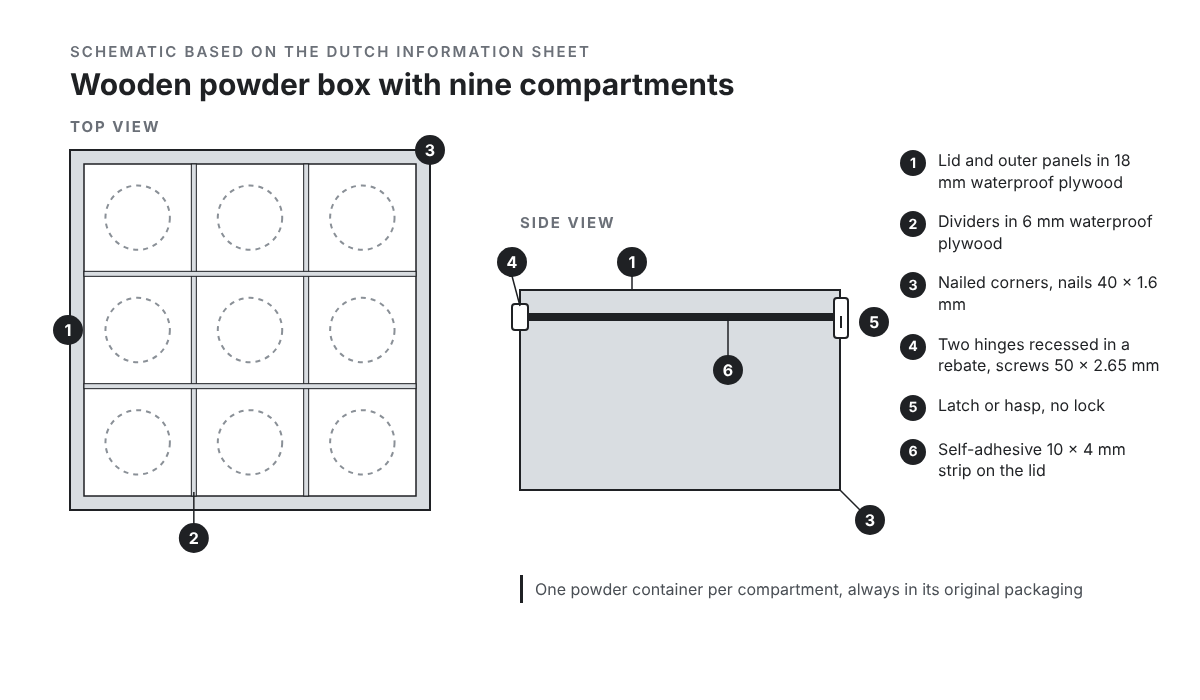
Schematic based on the specifications in the information sheet. The official dimensioned drawing is in the sheet itself.
Outer panels and lid in 18 mm waterproof plywood
Dividers in 6 mm waterproof plywood, fixed to the outer panels with small nails
Nailed corner joints, using nails 40 mm long and 1.6 mm thick
Two hinges, recessed into a rebate and fixed with screws 50 mm long and 2.65 mm thick
A latch or hasp, but no lock
A self-adhesive 10 x 4 mm strip on the lid
You can adapt the size and number of compartments to your own containers. With 1 lb (454 gram) bottles, six of them, just over 2.7 kilos, keep you within the 3 kilo smokeless limit. Otherwise stick to the materials and construction as described, because the design was tested as a whole.
Why no lock?
The information sheet is explicit here: no lock. The lid needs to be able to open if pressure builds up, and a lock keeps it shut. To keep others away, choose a location only you have access to rather than locking the box.
Where to put the box
Location matters too. The information sheet lists these points:
Not in a room where people regularly spend time, such as the living room or bedroom
Preferably in a shed or attic
Out of reach of children
Not in an escape route, such as a hallway or stairwell
Well away from heat sources such as radiators, stoves or a boiler
No other chemicals, flammable liquids or gases in the same room
Nothing on top of the box, keep the lid clear
No smoking or open flames in the storage room, including candles, an open fire, grinding or welding
A suitable fire extinguisher within reach
The last two points deserve attention if you store powder in the garage or workshop. That is often where grinding and welding happen and solvents are kept, and for many reloaders it is also where the reloading bench stands.
At the reloading bench
The box is for storage. At the bench the same principle applies: as little powder outside its packaging as possible. Take out only the bottle you are using, and pour whatever is left in the hopper or powder dispenser back into the correct original container when you are done.
Working with several powders? Never have two bottles open at once. A mix-up is not just bad news for your load, the information sheet also explicitly advises against mixing powders.
Frequently asked questions
Can I keep powder in my gun safe if it does not seal completely?
No. A gun safe is designed to stay shut. Store powder in a wooden box, separate from your firearms and ammunition.
Does powder in my dispenser or hopper count?
Yes, all powder in the house counts towards the 1 and 3 kilo limits. Pour leftovers back into the original container after reloading.
What should I do if powder is stolen?
Always report it to the police. The information sheet says so explicitly.
Does this apply to factory ammunition?
No. The sheet only covers loose powder. Ammunition falls under the Weapons and Ammunition Act and is stored according to the rules for firearms and ammunition.
Download the information sheet
The complete information sheet, including the official construction drawing, is available as a PDF (in Dutch).
Download the information sheet (pdf, Dutch)
Further reading
Getting a firearms licence in the Netherlands as a sport shooter
Import consent: bringing a firearm into the Netherlands via Dutch Customs (CDIU)
Sources (in Dutch): information sheet "Veilige opslag van kruit bij particulieren" (September 2020, published by the Ministry of Infrastructure and Water Management, RIVM, ILT, KNTS, KNJV, KNSA, Landelijk Platform Levende Geschiedenis and the National Police), Information Point: storing explosives and politie.nl: explosives or reloading registration. This article is not legal advice. Powder is a hazardous substance, always handle it with care.