
Last checked on 6 October 2026 against the Dutch Weapons and Ammunition Act, the Weapons and Ammunition Regulation and the 2019 Weapons and Ammunition Circular.
Getting your own rifle or pistol licensed in the Netherlands is a slow, structured process. Expect around eighteen months before you can collect your first firearm, and another two years before every sport shooting discipline is open to you. This guide follows the route step by step, from your first evening as a probationary member to the day you can add a semi-automatic rifle to your licence.
Throughout the article we separate two things that often get mixed up: what the law requires, and what is club policy.
The short version
Probationary (aspirant) membership: usually about six months, including a certificate of conduct and an introduction course, set by the club under the KNSA model
Then at least twelve months as a full member, with at least 18 shooting sessions in the twelve months before you apply
First licence year: one firearm for an Olympic discipline, no semi-automatic rifle
After the first renewal: ISSF and MLAIC disciplines as well, such as large bore pistols and revolvers up to 9 mm/.38 and large bore bolt action rifles, up to five firearms
From the second renewal: the remaining KNSA disciplines, including semi-automatic rifles
The route at a glance
Step 1, about 6 monthsIntroduction and probationary membership
Certificate of conduct, introduction course, supervised shooting with club firearms.Step 2, at least 12 monthsFull member
At least 18 sessions, competition shooting, a signed shooting log.Step 3First licence application
In person at the police licensing team, with forms WM3 and WM32, interviews and a safe inspection.Licence year 1One firearm
Suitable for an Olympic discipline, for example a .22 rifle or pistol.Licence year 2Large bore added
ISSF and MLAIC disciplines, up to five firearms.Licence year 3Semi-automatic rifle
The remaining KNSA disciplines and calibres above 9 mm.
Step 1: joining as a probationary member
Dutch clubs affiliated with the KNSA, the national shooting federation, all use a vetting process. It starts with an introduction course, at least four lessons spread over four to ten weeks under the KNSA model. Then comes the probationary period. A coach or mentor supervises you, and you will sit down with the board at least once.
The KNSA model sets the probationary period at a minimum of five months, and full membership can only follow once at least six months have passed. Many clubs add a minimum number of shooting sessions, twelve is a common figure. Those are club rules. Dutch law itself has no probationary period and no requirement of twelve sessions, so ask your club how they handle it.
Certificate of conduct
New members provide a certificate of conduct (VOG). You also need it to be registered with the KNSA, after which you receive your KNSA licence. The screening profile used here is one of the strictest there is.
Which firearms can you use?
Club firearms only. Anyone who has been a full member for less than a year may only borrow firearms suited to Olympic and ISSF disciplines, never a semi-automatic rifle. In practice you will shoot the club's .22 rifles and pistols.
Want to try it before you sign up? As a guest you can shoot a firearm at most three times in twelve months, provided you are eighteen or older.
Step 2: twelve months as a full member, 18 sessions
This is the first hard requirement. Under the circular you must be a full member when you apply, and you must have been one for at least a year before applying. Your probationary months do not count towards that year.
From your first lesson, that makes roughly eighteen months.
On top of that, Article 43(4) of the Weapons and Ammunition Regulation requires at least eighteen shooting sessions in the twelve months before your application. How you spread them is up to you, with a few conditions:
Only one session per day counts, however many firearms you shoot (officially recognised championships excepted)
You keep a personal shooting log, validated by your club
Each entry shows the date, the club or range stamp, and the name and initials of a board member or range officer
Competition shooting
You also need to actively take part in a KNSA-regulated discipline, in competition. How many matches your club expects varies. Ask the board early, because they will confirm on your WM3 that you meet the requirements.
Step 3: your first licence application
Licences are granted by the chief of police and handled by the Korpscheftaken team of the police unit where you live. You apply in person, you need to identify yourself, and you must be at least eighteen.
What to bring
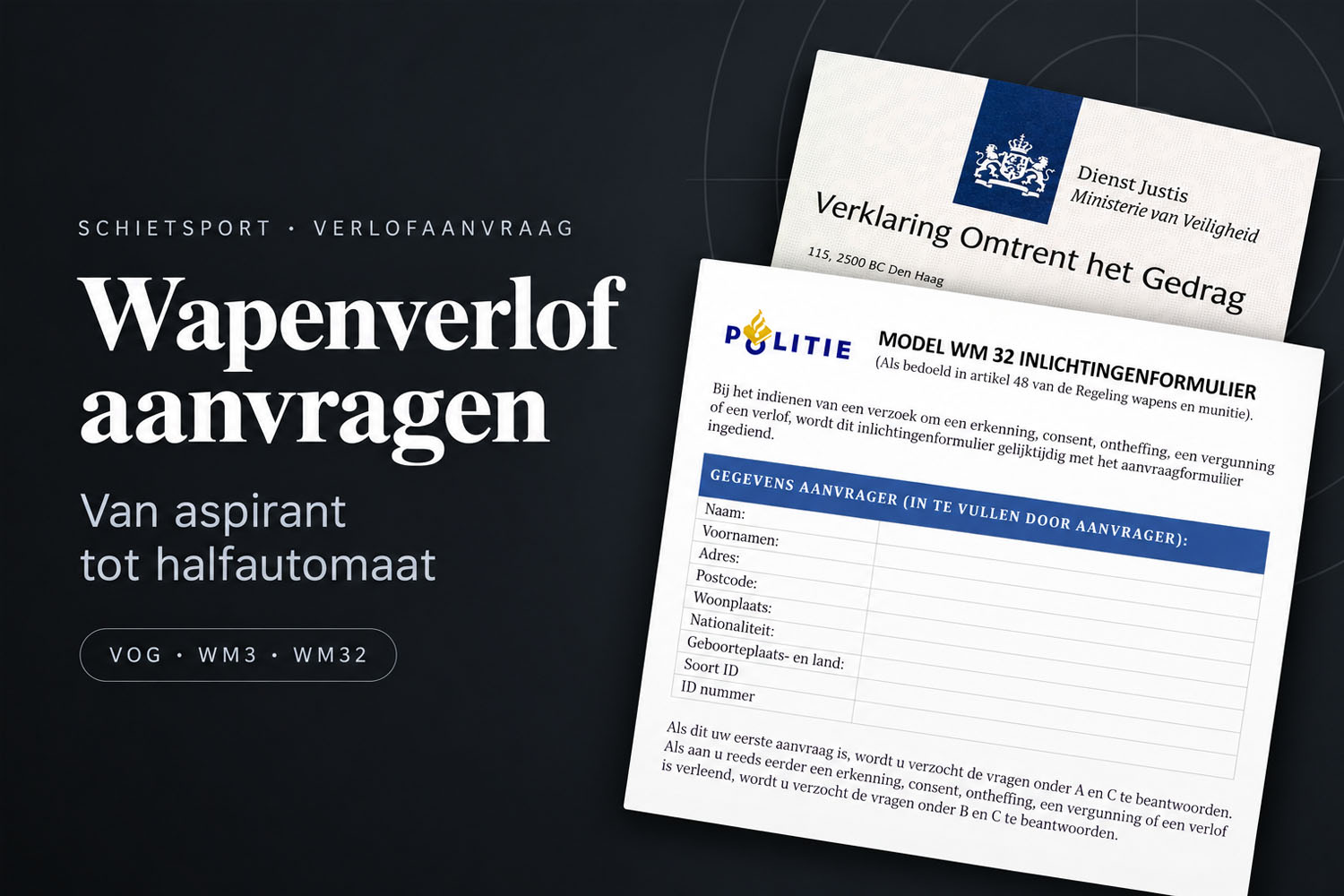
A completed application form WM3 for each firearm, with your club's declaration in section 6
The information form WM32, with three referees
Two passport photos
Your shooting log
Valid ID
The option slip or purchase agreement for the firearm you want to buy
Our article on forms WM3 and WM32 explains how to fill them in and who signs what.
Signed in ink, original at the inspection
Have your club board sign the forms with a pen. A digital signature or a pasted scan will not do. You can often email a copy to the licensing team in advance, but when you present the firearm for inspection you hand in the original WM3 with the wet signatures. No original, no registration of the firearm on your licence.
Interviews and safe inspection
Expect at least three personal contacts with the police. One of them usually takes place at home, where they inspect your gun safe before the licence is granted. Buy the safe before you apply, not after.
Once approved
You receive the licence itself and an acquisition permit. With the acquisition permit you collect the firearm from the dealer or seller. You then present it to the licensing team within the period they give you, so they can check the serial number against your licence.
Fees
Action | Fee |
|---|---|
First licence | €138.20 |
Renewal | €68.20 |
Amendment, for example adding a firearm | €30.00 |
Amounts as listed by the KNSA under Article 50 of the Weapons and Ammunition Regulation. Fees can be adjusted annually, so check the current amount with the licensing team.
Your first licence year: one firearm
A fresh licence still means starting small. Article 43(6) of the Regulation limits you to a single firearm suitable for an Olympic discipline during your first licence year, and section B 2.4.4 of the circular adds that it cannot be a semi-automatic rifle.
Most people end up with a .22 rifle or a .22 sport pistol. A shotgun for trap or skeet also counts as an Olympic discipline.
Pick something your club actually trains and competes in. You will need another eighteen sessions with it before your renewal.
Member for more than two years?
The circular offers a second route here. If you apply for your first licence after more than two years of membership at a KNSA-certified club, you qualify straight away for the firearms of the next phase described below. Talk to your board and the licensing team beforehand about how that works out in your case, including how many firearms you can have in that first year.
First renewal: adding large bore
A licence is valid for one year at most (Article 28(4) of the Act) and is renewed as long as you still meet every requirement. Submit it to the licensing team at least two weeks before it expires, together with:
Your current licence and its annex
Valid ID
A newly completed WM32, which you fill in again at every renewal
Your shooting log showing at least 18 sessions in the past licence year
Your KNSA licence
At this first renewal the range of firearms opens up. You now qualify for firearms suited to the Olympic, ISSF and MLAIC (muzzle loader and historic arms) disciplines, with semi-automatic rifles still excluded. In the KNSA phasing this includes:
Large bore pistols and revolvers up to 9 mm/.38
Large bore single shot or bolt action rifles
Historic and muzzle loading firearms
So it is not only semi-automatic pistols up to 9 mm, a revolver in .38 Special or 9 mm qualifies too. Larger calibres such as .45 ACP or .44 Magnum belong to the next phase.
For precision shooters this is usually when the first bolt action rifle arrives, often in .308 Winchester or 6.5 Creedmoor, for 300 metre matches and long range competition.
Five firearms maximum
Article 43(1) caps your licence at five firearms. You can only go above that by showing that six or more are essential for your shooting. According to the circular this has to be confirmed by the KNSA and supported by your club board, and it is meant for exceptional cases.
Every additional firearm is added with a new WM3. And the licence only covers firearms you actually use for a discipline within your club (Article 43(5)).
Second renewal: the semi-automatic rifle
The circular explicitly excludes semi-automatic rifles from the first two phases. Under the KNSA phasing you can apply for one at your second renewal, along with the remaining regulated disciplines and calibres above 9 mm. In practice that means your third licence year.
High capacity magazines
Centrefire semi-automatic firearms are subject to extra rules from the EU Firearms Directive. A long gun with a magazine holding more than ten rounds, or a handgun with a magazine of more than twenty, falls into EU category A. You only have a legitimate reason for such a magazine if you use it in a discipline designated by the minister (Article 7(4) of the Weapons and Ammunition Decree and Article 43a of the Regulation).
The club board states on your WM3 whether the capacity is ten or twenty rounds. Rimfire .22 is outside this rule.
What is never allowed
A semi-automatic long gun that can be shortened to under 60 centimetres with a folding, telescopic or tool-free removable stock without losing function. No licence is granted for these (Article 28(6) of the Act). Worth checking when you look at modern chassis systems and stocks.
Phases at a glance
Phase | When | What is allowed | Legal basis |
|---|---|---|---|
1 | First licence year | One firearm for an Olympic discipline, no semi-automatic rifle | Art. 43(6) Regulation, Circular B 2.4.4 |
2 | From the first renewal, or a first application after more than two years of membership | Olympic, ISSF and MLAIC disciplines, including large bore pistols and revolvers up to 9 mm/.38 and bolt action rifles, five firearms maximum | Circular B 2.4.4, Art. 43(1) Regulation, KNSA phasing |
3 | From the second renewal | Remaining KNSA disciplines, including semi-automatic rifles and calibres above 9 mm | KNSA phasing |
Storage, transport and ammunition
Firearms and ammunition are stored separately, in a purpose-built lockable gun safe or an equivalent safe. A safe under 200 kilos must be properly anchored to the floor or wall (Article 43c of the Regulation). The police carry out an unannounced home check at least once every three years.
Your licence also covers the matching ammunition. The usual limit is 10,000 rounds, although the chief of police can set a lower figure with reasons.
You may only transport firearms between your home, the range, a licensed dealer and the police station. The firearm is cased, unloaded, uncocked and with an empty magazine, and never left unattended in a car. Heading to a match abroad? Read the section on the European Firearms Pass in our article on transfer licences.
Planning to reload? Gunpowder is not covered by your firearms licence but by the Dutch Civil Explosives Act. That same article explains what you need.
Changes ahead
On 17 June 2026 the Minister of Justice and Security announced a revision of the Weapons and Ammunition Act. Plans include a mandatory independent psychological assessment, compulsory liability insurance and mandatory training. A public consultation is expected in the first half of 2027, with the bill going to parliament at the end of 2027. Until then, the rules in this article apply.
On 1 October 2026 the circular changed on one point: the separate section for returning licence holders was removed. If you stopped shooting at some point and want to return, ask the licensing team how your situation is assessed now.
Frequently asked questions
Does my probationary period count towards the year of membership?
No. The circular requires a year of full membership before you apply, so the probationary months come on top.
Do I need eighteen sessions with each firearm?
No, eighteen in total with any firearm, one per day. Bear in mind that the licence only covers firearms you actually use, so a rifle that never leaves the safe may raise questions at renewal.
How long until I own my first firearm?
From your first lesson to collecting the firearm is usually eighteen months to two years. Police processing times differ per unit, so ask about current waiting times when you book your appointment.
What if I fall short of eighteen sessions?
The Regulation makes an exception when the shortfall cannot reasonably be held against you, for example due to long-term illness. Report it to your club and the licensing team in good time, with supporting evidence.
Further reading
Official sources (in Dutch): Weapons and Ammunition Act, Weapons and Ammunition Regulation, Weapons and Ammunition Circular 2019, politie.nl: applying for a licence and politie.nl: renewing a licence. This article was compiled with care but is not legal advice. Procedures can differ between police units. If in doubt, check with your club or the licensing team on 0900-8844.