
Last checked on 6 October 2026 against the Dutch Civil Explosives Act and information from the ILT, the KNSA and several municipalities.
Since 1 September 2026, every Dutch reloader has noticed it at the counter: no transfer licence, no powder. That is the date the Human Environment and Transport Inspectorate (ILT) started enforcing a rule that had been in the law for years but was rarely applied in practice.
This article explains what the transfer licence (overbrengingsvergunning) is, which registration you need first, where to apply and what it costs. Because the word transfer also comes up with firearms, the final part covers taking or selling a firearm across a border.
The short version
For gunpowder you need two things: a civil explosives registration (Wecg-erkenning) from the police and a transfer licence from your municipality
The registration is issued by the police licensing team and is valid for up to five years
The transfer licence is issued by the municipality where the transport ends, usually where you live
Statutory fee per application: €121, processing time up to eight weeks, validity varies by municipality
Factory ammunition is not covered, loose powder is, and more and more municipalities include primers
Why now?
The requirement comes from Article 10 of the Civil Explosives Act (Wecg) and is not new. Enforcement is. Early in 2026 the ILT told dealers that from 1 March 2026 powder could only be sold to buyers holding a transfer licence. After talks with the KNSA, the date was pushed back to 1 September 2026, giving shooters and municipalities time to prepare.
That date has passed. Dealers now ask for your paperwork with every powder purchase, and the ILT checks that they do.
What the law says
Article 10 prohibits transferring explosives when the transfer ends in the Netherlands and the recipient holds no licence for it. Under this Act, transfer means any physical movement of explosives within the European Union. That includes the drive from the gun shop to your home, not just a shipment from abroad.
The key distinctions:
Loose powder, both black powder and smokeless powder, falls under the Wecg
Factory ammunition is explicitly excluded (Article 2 of the Wecg) and is covered by the Weapons and Ammunition Act and your firearms licence
Primers are a grey area. Firearms legislation treats them as ammunition components, yet they are explosive articles too. A growing number of municipalities therefore include them in the transfer licence, some only if they are also listed on your registration
Our advice: have primers listed on both your registration and your transfer licence. That covers you either way.
Which substances are covered?
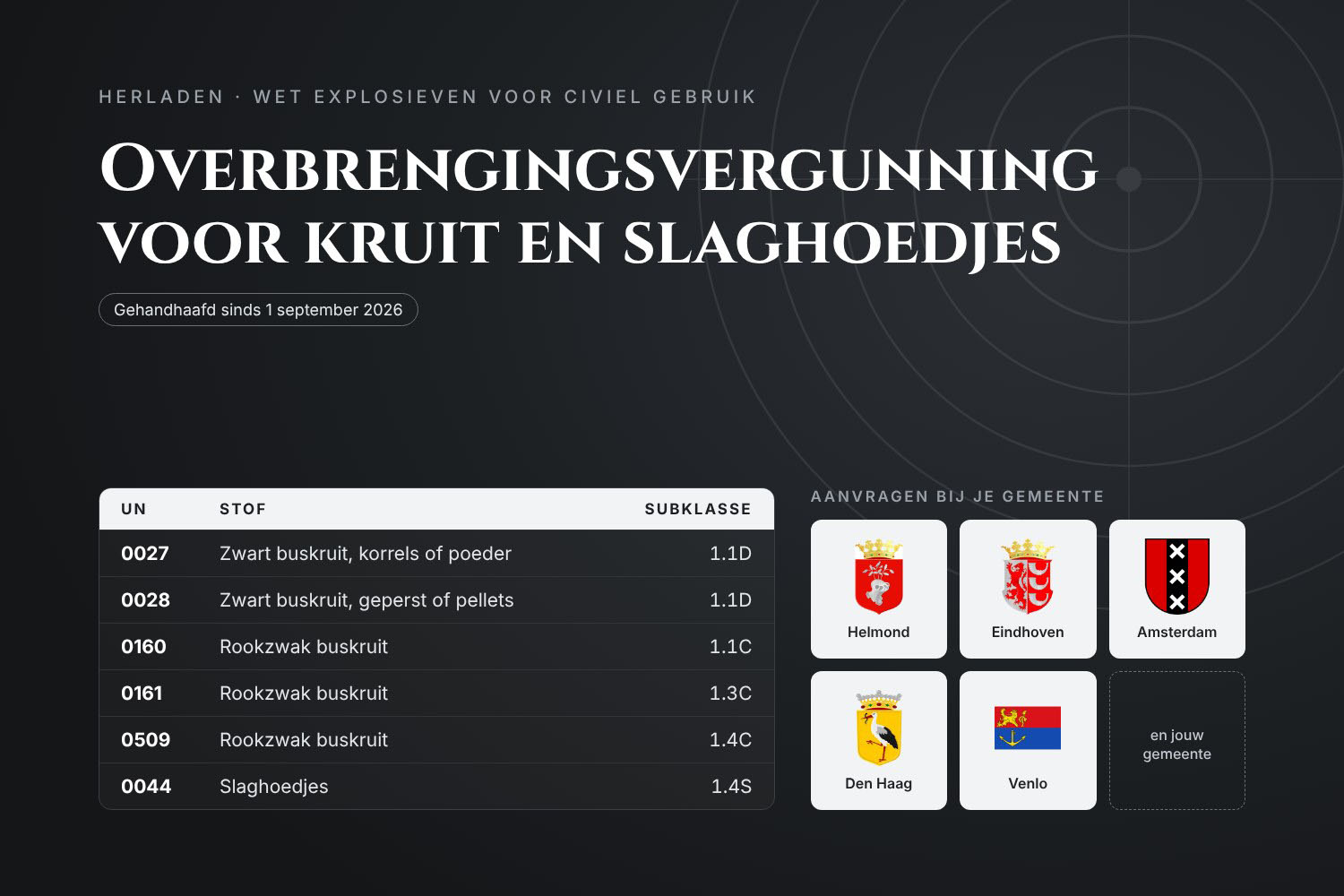
Application forms and licences identify powder and primers by their UN number, the international code for dangerous goods. These are the numbers that matter for sport shooters, reloaders and hunters:
UN number | Substance | Division |
|---|---|---|
UN 0027 | Black powder, granular or meal | 1.1D |
UN 0028 | Black powder, compressed or in pellets | 1.1D |
UN 0160 | Smokeless powder | 1.1C |
UN 0161 | Smokeless powder | 1.3C |
UN 0509 | Smokeless powder | 1.4C |
UN 0044 | Primers, cap type | 1.4S |
The UN number is printed on the packaging. The same smokeless powder can fall under a different division depending on brand and packaging, so if in doubt ask your dealer for the correct numbers and have every number you use listed on your licence.
Step 1: the civil explosives registration
Under Article 17 of the Wecg you may not store, use or transfer explosives without a registration (erkenning). You apply to the chief of police, in practice the same Korpscheftaken team that handles your firearms licence.
Validity: up to five years
Fee: €121, renewal €60
For private individuals it is in practice only granted alongside a firearms licence or hunting permit
Already registered? Check what is on it and when it expires. Municipalities often tie the validity of the transfer licence to that of your registration.
Step 2: the transfer licence
As the recipient, you apply to the municipal executive of the municipality where the transfer ends (Article 11 of the Wecg). For powder you buy in a shop and take home, that is where you live. Among other things, the municipality checks that your registration is valid.
Most municipalities use an online form with DigiD, a few still work by email. What to expect:
Item | What to expect |
|---|---|
Fee | Set by law at €121. A few municipalities charge a different amount |
Processing time | Eight weeks, extendable once by six weeks |
Validity | Varies by municipality: per transport, one year, or the same as your registration (up to five years) |
Attachments | Usually a copy of your registration, your firearms licence or hunting permit and your ID |
Applying by municipality
Each municipality handles applications in its own way. Some have an online form, others do not yet. A few examples:



Amsterdam
No dedicated page yet, call 14 020
Den Haag
No dedicated page yet, call 14 070
Venlo
No dedicated page yet, call 14 077
Municipality not listed? Search its website for "overbrengingsvergunning", or call the general number: 14 followed by the local area code.
Ask for the longest validity
Since validity differs between municipalities, it pays to ask whether the licence can cover multiple transports and run for as long as your registration. A licence per transport means another €121 and another wait with every purchase.
Buying powder in practice
Dealers ask for your registration and a valid transfer licence. Without both, no powder is handed over or shipped. Some shops send powder under the dangerous goods rules (ADR), others now only offer collection.
Transporting powder yourself by car? The KNSA, based on the transport regulations, puts the limit at 1 kilo per journey.
Storage at home
For storage at home the KNSA works with a maximum of 1 kilo of black powder or 3 kilos of smokeless powder. The rules for small quantities kept by private individuals are still being amended in the Environmental Activities Decree, expected from 1 July 2027. Keep powder dry and cool, in its original packaging and separate from primers.
Powder from abroad
Buying powder in Germany or Belgium adds another layer. On top of your registration and your municipal transfer licence, international transport requires permission from the ILT. According to the ILT, you need approval from every country the explosives leave, pass through and enter.
ILT approval: €127, valid for up to one year, processing time up to eight weeks
Attachments: your municipal transfer licence and your registration
See the ILT page on international transport of explosives (in Dutch). For most reloaders, buying from a Dutch dealer is far simpler.
And with firearms: what does transfer mean there?
In the EU Firearms Directive, moving a firearm from one member state to another is also called a transfer. Dutch law, however, has no separate transfer licence for firearms. The permit is called a consent and is issued by Dutch Customs (CDIU).
Selling a firearm or moving to another EU country
When a firearm leaves the Netherlands for good, a consent for exit is always required (Article 14(4) of the Weapons and Ammunition Act). The CDIU only grants it once you show that the destination country has no objection. Afterwards the firearm is removed from your licence. Our article on consent via the CDIU explains the application.
Taking your firearm to a match abroad
For a match in another EU country you usually do not need a consent. You travel with the European Firearms Pass listing your firearms, plus an invitation from the organising club.
You apply for the European Firearms Pass at the police licensing team, it is valid for up to five years
The Weapons and Ammunition Regulation exempts sport shooters living in the Netherlands from the consent under conditions: the firearm is on your licence, you hold a written invitation from a foreign shooting club, the firearm is cased and you carry no more than 1,000 rounds
Some countries add their own requirements, Sweden for instance does not accept the pass without a separate import permit. Always check the rules of the destination country
Matches outside the EU, such as in the United Kingdom
Sport shooters temporarily leaving the EU with a European Firearms Pass and proof of the purpose of the trip need no EU export licence, within fixed ammunition limits. On the British side you need a Visitor's Firearm Permit, applied for by a sponsor in the UK, usually the organising club. Start months in advance.
Frequently asked questions
Do I need a transfer licence for factory ammunition?
No. Ammunition falls under the Weapons and Ammunition Act and is covered by your firearms licence. The transfer licence concerns loose powder and, depending on your municipality, primers.
I still have powder bought before 1 September 2026. Do I need to do anything?
The transfer licence covers transport to your address, so powder you already had at home before that date has already been transferred. You do need a valid civil explosives registration to store and use it.
Who applies when a shop ships the powder to me?
You, as the recipient. The transfer ends at your address, so the licence has to be in your name.
My municipality has no form yet. What now?
Contact the municipality's permits department or the regional environmental service. The obligation applies nationwide, even if the online form is still missing.
Further reading
Getting a firearms licence in the Netherlands as a sport shooter
Import consent: bringing a firearm into the Netherlands via Dutch Customs (CDIU)
Official sources (in Dutch): Civil Explosives Act, Regulation on Wecg registration fees, ILT: civil explosives and the Weapons and Ammunition Regulation. This article is not legal advice. Fees, validity and procedures can differ by municipality, check the current information with yours.