

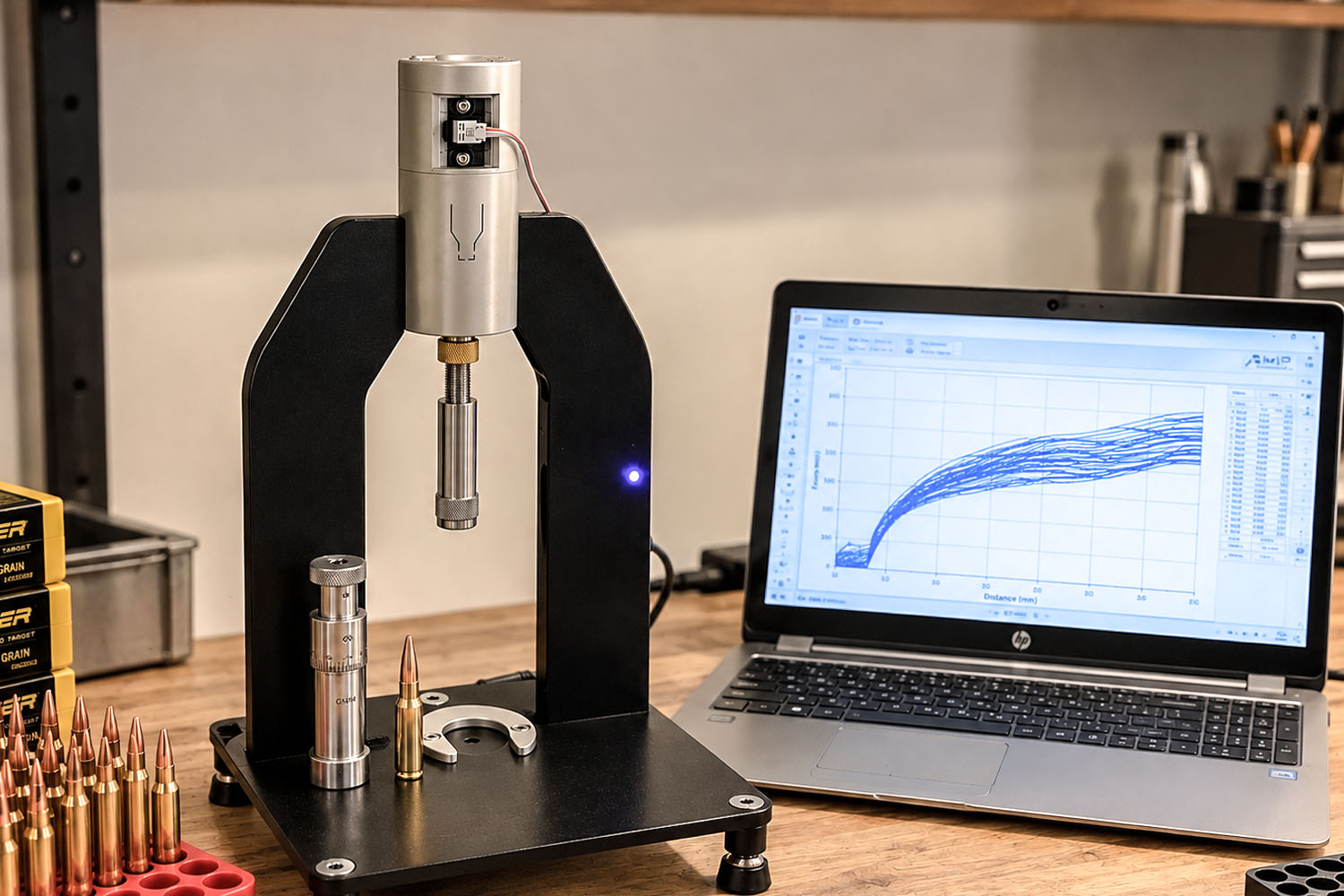
The last step of reloading, seating the bullet, is exactly where a lot of spread hides. We dig into neck tension, what you can read from seating force, and the three ways shooters seat bullets.
You can weigh your cases to the hundredth of a grain, turn your necks uniform and meter your powder to the kernel, and still see unexplained fliers on paper. Often the cause sits in the last step most reloaders do purely by feel, seating the bullet. The force needed to do that, the seating force, is a measurable reflection of the grip and friction between case neck and bullet, and that grip helps decide how your round ignites and how your powder burns. In this article you will read what neck tension really is, why it makes or breaks your groups, what a force-distance graph reveals, and how the different ways of seating bullets compare.
What neck tension really is
Neck tension is a confusing term, because there is no real tension in the classic physics sense behind it. What we mean in practice is the grip the case neck has on the bullet, in other words the amount of clamping. That grip comes from the inner diameter of the neck being just slightly smaller than the bullet, the so-called interference fit. When seating, the neck is expanded by the bullet, and the spring-back of the brass plus the friction between brass and bullet jacket together form the force that holds the bullet in place.
It is important to keep two things apart. The interference, the amount by which you make the neck smaller than the bullet, is set by your bushing or sizing die. The seating force, the force you measure while seating, is the result of that interference plus the condition of your brass and the state of the neck surface. Two cases with the same bushing size can therefore still show a different seating force, and it is exactly that difference that is interesting.
Why it makes or breaks your groups
The amount of grip on the bullet influences how the bullet releases at ignition. A neck that grips firmly one time and loosely the next gives the bullet a slightly different start every time, and that can feed into the initial pressure, the powder burn and your muzzle velocity. A varying grip is therefore one of the possible sources of a higher extreme spread and standard deviation, and at long range such velocity spread translates into vertical spread on target. It is not the only factor, but it is one you can control.
The heart of the matter is not that you have to chase a specific absolute neck tension, but that you want to keep that tension as consistent as possible from case to case. For precision reloading it is therefore less about maximum neck tension than about consistent neck tension from round to round. A load with a slightly higher but very even grip usually performs better than a load with a lower but strongly varying grip. Consistency beats the exact number.
Seating force, the measurable side of neck tension
You cannot see neck tension directly, but you can feel it and, better still, measure it. As the bullet goes into the neck, a force builds up. Plot that force against the distance the bullet travels and you get a force-distance graph, also called the seating force curve. That curve is like a fingerprint of the seating process. Across a consistent set of rounds you expect curves that sit close together in shape and force. Deviating peaks, dips or shifts between individual curves can point to differences in case prep, geometry, interference or friction.
What the graph reveals
Once you have seating force in view, the graph becomes a diagnostic tool. Under the hood of a single curve sit surprisingly many signals about your case prep. This table sums up the most common ones.
What you see in the curve | What it probably means |
|---|---|
Force peak as the bullet first enters | Chamfer, the condition of the case mouth or the initial interference |
Different curve height between cases | Differences in grip and friction, brass condition or neck surface |
Gradually rising force over many cases | Work hardening, your brass is getting harder and calls for annealing |
A drop in the last part of the seating stroke | The bullet bearing surface may be passing beyond the sized portion of the neck |
An event that shifts horizontally between curves | A possible difference in trim length or geometry, so in where the resistance arises |
Jagged, local peaks | Irregular friction, contamination or differences in the neck surface |
Structurally too low or too high force | Your bushing or expander size does not match your desired grip |
Note the word probably. The graph points you in a direction, but you draw the conclusion by linking it to what you did to your case prep yourself. It is exactly that combination of measuring and thinking that makes it valuable.
Total Work Done, one number to steer by
Peak force is useful, but it only tells part of the story. Two cases can reach the same peak while one delivers that force briefly and the other across the whole seating stroke. That is why serious reloaders look at the area under the curve, the so-called Total Work Done. That is the total work needed to seat the bullet, force multiplied by distance, and it captures both the height and the shape of the curve in a single number. Sort your rounds by Total Work Done and you group rounds whose whole seating process is very similar in terms of measured work. That makes outliers visible and gives you an extra variable to line up later against your muzzle velocity and your results on target.
Three ways to seat bullets
Now that the theory is clear, the practical question gets interesting, how do you actually get hold of that information. Broadly there are three levels, from pure feel to fully measured.
By feel. Most reloaders seat bullets with a normal threaded press or with an arbor press, such as the K&M precision arbor press or the high grade arbor press by Derraco Engineering, and judge the resistance with their hand. For many uses that is fine, but your hand is not a measuring instrument. You only feel a flier if it is extreme, and small differences are hard to judge objectively by hand. You cannot quantify them or compare them afterwards, so you have nothing to sort by.
With a force gauge. A step further are arbor presses with force measurement, such as the K&M arbor press with power package and indicator, or the 21st Century Hydro seater with a pressure gauge. These let you read the peak force per round, so you can recognise fliers and sort your cases. The drawback is that you read one number per case and note it by hand, and you do not see the shape of the curve, the whole movement.
Measured and recorded. The highest level is a press that builds the full force-distance graph and stores it digitally. The AMP Press is the best known example, with a motor driven ram for a repeatable stroke, a load cell and a position sensor. You see not just the peak but the whole curve and the Total Work Done, and you store every session to compare loads over time. This also removes the human variable of the hand-operated stroke from the measurement.
Approach | What you get | Limitation |
|---|---|---|
By feel (threaded or arbor press) | Fast, simple, cheap | No measured value, no objective sorting, small differences difficult to quantify |
With force gauge (K&M power package, 21st Century Hydro) | Peak force per case, spot fliers, sort | One number, read by hand, no curve or record |
Measured and recorded (AMP Press) | Full curve, Total Work Done, digital storage and comparison | Bigger investment, works with inline seating dies |
From measuring to better loads
Measuring is not a goal in itself, it is a means to make decisions. Once you have seating force in view, you can set your fliers aside instead of shooting them in a match string. You can set aside rounds with a strongly deviating seating force and then use chronograph and target data to investigate whether that deviation also shows up in the ballistic performance. And you can validate the effect of your case prep, because if you start annealing to stabilise your neck tension, the graph shows in black and white whether it works. The same goes for a new bushing size, a different expander or cleaning your necks.
A note on annealing
Annealing can clearly change the seating force and the shape of the curve. In some tests a lower and smoother seating force was measured after annealing, but that does not have to work out the same way in every sizing setup. Annealing also changes the neck's spring-back, so the same bushing can produce a different final interference. So do not look only at the absolute force, but above all at reproducibility, and re-check your final neck diameter and sizing when you start annealing.
This is exactly where the rest of your precision process connects. If you want to tackle the biggest source of varying neck tension at the root, you arrive at keeping the hardness of your brass even, and you do that with annealing, for example with an induction annealer like the AMP MARK II. Measuring and annealing reinforce each other, one shows what is going on, the other addresses the cause.
Is measuring worth it for you?
If you shoot recreationally at short to medium range, good consistent case prep and seating by feel already get you a fine result. As soon as you shoot at long range and your first shot has to count, whether you do ELR, F-Class, benchrest or PRS, every grain of spread starts to matter and seating force becomes a variable you want to control. Start with deliberate, consistent prep, consider annealing to keep your brass even, and if you really want to know what happens inside your necks, you start measuring. That turns bullet seating from a matter of feel into a process you can steer on data.
Questions about neck tension, annealing or measuring seating force for your caliber and discipline? Feel free to get in touch, we are happy to help.