
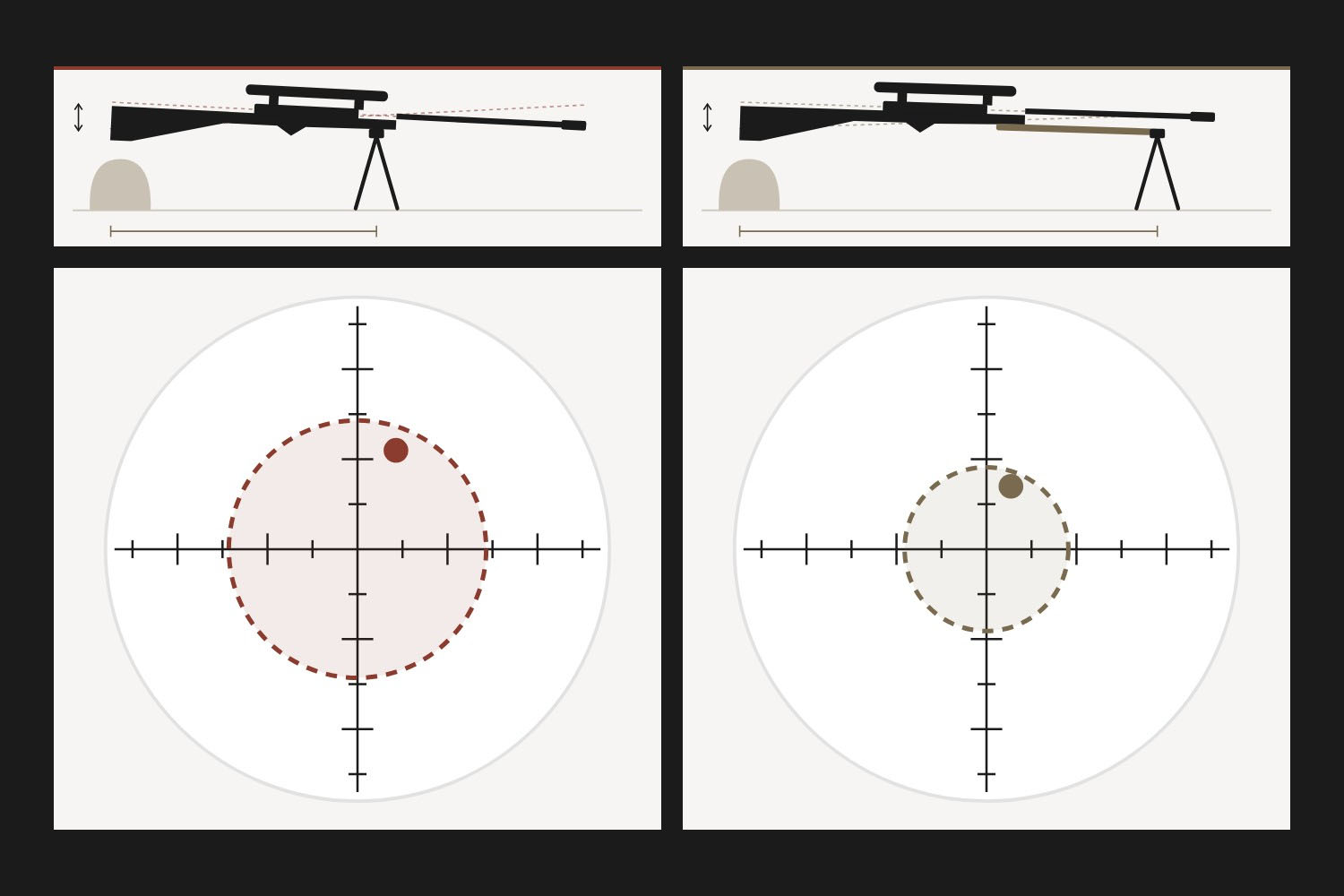
You're settled in behind the rifle, the wind drops for a moment and everything lines up. Still, the reticle keeps drifting around the target. More often than you'd think, that has little to do with your technique.
Where your bipod sits plays a bigger part. A bipod extender moves the support point forward, towards the muzzle. Using two animations and a worked example, we'll show why that matters so much, and which Accuracy Solutions BipodeXt suits your rifle.
Why your reticle keeps moving
Nobody lies perfectly still. Your pulse, your breathing and tension in your shoulder all create small movements behind the rifle, often no more than a millimetre. You barely feel them.
The angle this creates is the same at any distance. On target, though, it turns into more and more centimetres.
At 600 or 1000 metres, a tiny change in angle adds up to decimetres. How big that angle gets depends largely on one measurement: the distance between the toe of your stock and your bipod.
The lever effect, visualised
Your rifle rests on two points: the bipod up front and your shoulder or a rear bag at the back. In this simplified model, the bipod is the pivot. Every small unintended movement at the rear, a heartbeat, a breath or a bit of pressure on the stock, tilts the rifle around that pivot. The shorter the distance between the toe of the stock and the bipod, the larger the angle the same movement creates.
If the shot breaks at that moment, the barrel points in a slightly different direction. The maths is simple: displacement of the aiming point at the target = movement at the stock × target distance ÷ toe to bipod distance. With 1 mm of unintended movement and a target at 1000 metres, a bipod at 70 cm gives you 1.43 mrad, with the pivot at 110 cm it drops to 0.91 mrad. This is a simplified example of tilting around the bipod, not a measured improvement in group size. Reticle movement only turns into a shift in point of impact if the shot breaks at that moment.
Target distance | Bipod at 70 cm | Pivot at 110 cm |
|---|---|---|
300 m | 43 cm (1.43 mrad) | 27 cm (0.91 mrad) |
600 m | 86 cm (1.43 mrad) | 55 cm (0.91 mrad) |
1000 m | 143 cm (1.43 mrad) | 91 cm (0.91 mrad) |
Theoretical displacement of the aiming point for 1 mm of movement at the stock.
The gap grows with distance. At 300 metres it is a few hand widths, at 1000 metres it is more than half a metre. That's why a steadier sight picture pays off most in long range and ELR shooting.
What this model does and doesn't tell you
This calculation assumes a rigid rifle tilting purely around the bipod. In practice your shoulder, the rear bag, the bipod and the ground together form the support, and each of them absorbs part of the movement. So an extender won't halve your group on its own. Moving the support point forward can reduce the influence of movement behind the rifle. How much of that you notice depends on your whole setup.
Calmer after the shot: recoil and spotting impacts
A longer base doesn't only help while you aim. With the support point further forward, the rifle can jump up or twist sideways less after the shot. Accuracy Solutions lists better recoil management and easier spotting of your own impacts as key benefits. With heavier calibres in particular, that difference can be noticeable.
How much you gain depends on the rifle, the calibre and your position. You still need a well filled rear bag and consistent shoulder pressure. An extender makes a good setup better, it doesn't replace one.
Which BipodeXt suits your rifle?
It mainly comes down to the weight of your rifle and how far forward you want the support point. Both Gen4 models use the A&P mount, which clamps to ARCA and Picatinny rails without swapping parts. No bipod is included, you simply fit your own.
Model | Max. rifle weight (excl. bipod) | Length retracted / extended | Own weight |
|---|---|---|---|
MSR Pro Gen4 | 13.6 kg | 38.6 / 55.9 cm | 0.94 kg |
ELR Max A&P Gen4 | 29.5 kg | 51.4 / 99.6 cm | 1.79 kg |
For most precision rifles the BipodeXt MSR Pro Gen4 is the obvious pick. It's compact, light and quick to mount. On a Picatinny rail it's rated up to .375 CheyTac, on ARCA up to .300 Win Mag.
Running a heavy ELR rifle or a .50 BMG? Then look at the BipodeXt ELR Max A&P Gen4. Fully extended it's almost a metre long, so the pivot really moves forward, and it carries rifles up to 29.5 kg.
Sit lower on the extender with the Queen's Equalizer Kits
Because the extender sits between rail and bipod, your bore ends up a little higher above the pivot. The higher the bore sits above that point, the more leverage recoil has to push the front end up.
The Queen's Equalizer Kits lower the rifle on the BipodeXt. The standard kit drops it by 5.2 to 7.5 cm, the MINI kit by 2.7 to 4.9 cm. Which one you need depends on your bipod and the height you want to shoot at.
Setting up a bipod extender
Mount the extender square under the rail and use the supplied bubble level to check the rifle sits level.
Dealing with cant on sloping ground? Rotate the round tube in its clamp before you lock it down.
Extend the tube as far as the ground allows. Further forward gives more effect, although a shorter setting can be steadier on uneven terrain.
Load the bipod slightly forward, just as you would without an extender.
Fire a confirmation group after mounting. A different support point can shift your point of impact slightly.
Who gets the most out of a bipod extender?
You'll benefit most when shooting prone at long range. Think long range and ELR, bench style setups and hunting from a fixed position. That's where every tenth of a mil counts.
In PRS matches with lots of barricades and quick position changes, a long extender can get in the way. Shooters there often run a shorter setting or shoot certain stages without it.
You'll find every model and accessory on our Accuracy Solutions brand page. Not sure which version fits your rifle? Send us your rifle and bipod details and we'll help you choose.