
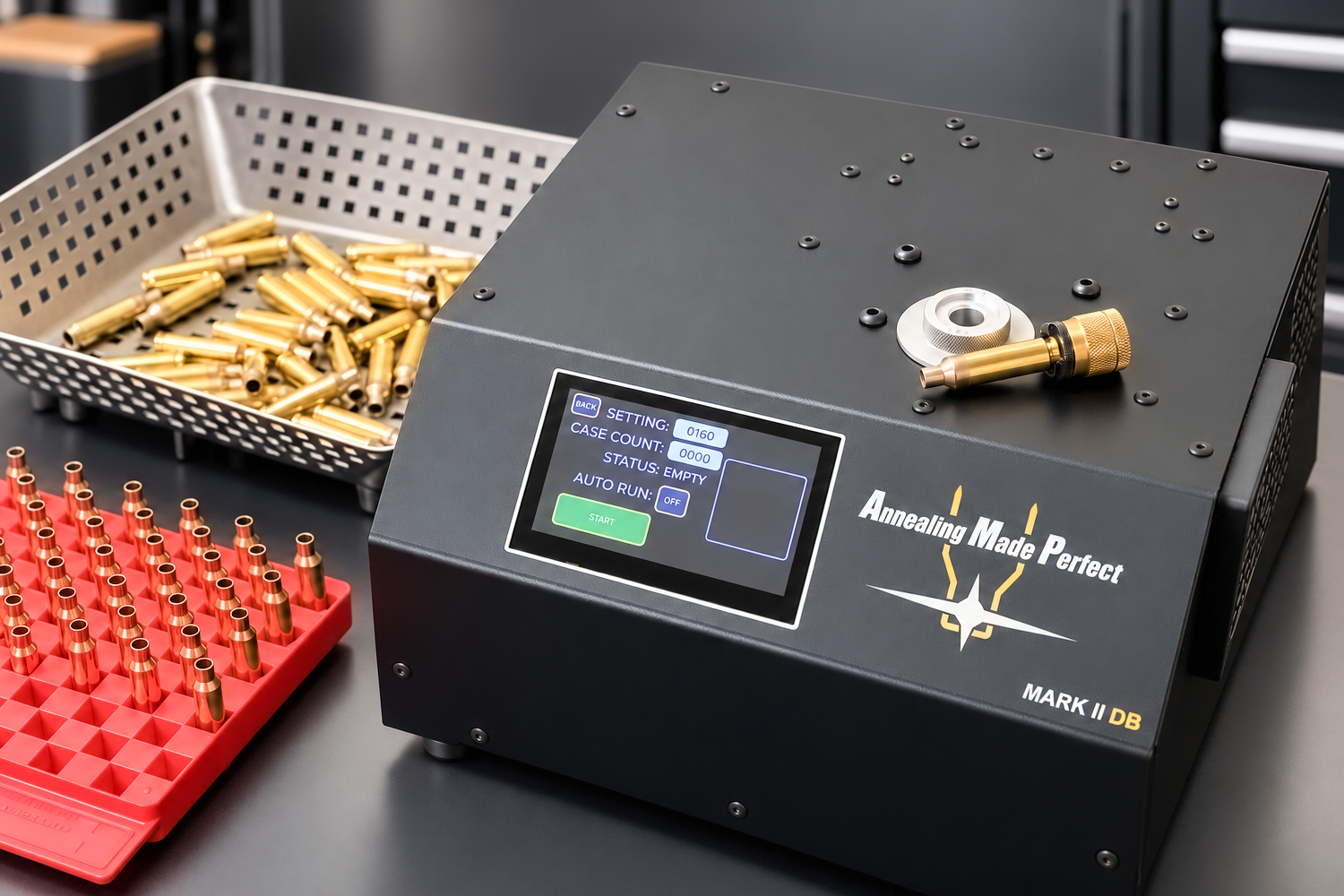
Last checked on 14 October 2026 against AMP's technical documentation, patents and its "Annealing under the Microscope" research series, the Shooting Technology and BurstFire documentation, and our own bench time with these annealers.
Ask a group of F-Class or benchrest shooters what they anneal with and the AMP comes up fast. It is expensive, it is built in New Zealand, and it works differently from any other annealer on the market. With AZTEC, the AMP works out a suitable setting for your batch of brass from a single sacrificial case.
This article takes the machine apart, figuratively. We cover how induction actually heats brass, what eddy currents are in plain terms, and why a gapped ferrite core behaves so differently from an ordinary coil. Then we get practical: how AZTEC reads your brass, how to pick the right pilot, what the AMP MATE adds, and how the AMP Press shows what annealing does to seating force. Finally we put the AMP next to the Shooting Technology Vulcano and the BurstFire 2-in-1, because the most expensive machine is not automatically the right one for every reloader.
The short version
A gapped ferrite core concentrates the magnetic field around the neck, while the eddy currents that do the heating form in the brass itself
Its settings are derived from micro-Vickers hardness testing in AMP's own lab, where its trials aimed for an average of roughly 98 HV
AZTEC analyses one sacrificial case and calculates an anneal code for the rest of that lot
The pilot sets how deep the neck sits in the gap, and a few millimetres already change the result
The AMP MATE makes it hands-free, the AMP Press measures seating force so you can see what annealing does to bullet grip
Vulcano and BurstFire cost less, but you dial in the setting yourself with time, position and temperature lacquer
Why annealing matters in the first place
Annealing locally softens the neck and shoulder of a case. It is needed because brass hardens whenever it is permanently deformed. Sizing does that, and so do seating and firing.
Each bit of plastic deformation makes the brass resist the next one a little more. That is work hardening, and it happens faster than most reloaders assume.
AMP measured it on .308 Win brass. In that trial annealed necks averaged about 98 HV on the Vickers scale, the figure AMP worked to there rather than a universal definition of correctly annealed brass. Sizing took it to around 125 HV and firing to about 150 HV. Left unannealed, the neck reached 168 HV by the fifth firing. For reference, the case head sits between 185 and 218 HV, and that is a zone you never want to touch.
Harder necks spring back more after they leave the die. A bushing die, a sizing die with an interchangeable neck bushing, squeezes the neck down, the brass rebounds slightly, and the harder it is the more it rebounds. The result is neck diameter and shoulder position that drift from one reload to the next, and neck tension, the grip of the neck on the bullet, that varies from case to case. If you want the fundamentals first, including the different methods and the classic mistakes, read why annealing is essential for reloaders. This article goes a level deeper.
AMP: from a Kiwi workshop to a hardness lab
Annealing Made Perfect was founded by father and son Alex and Matt Findlay. The company was registered in New Zealand in 2012 and spent the following years in development with Auckland University of Technology. A prototype appeared at SHOT Show in 2015 and the first machines shipped in 2016. By April 2022 unit number 10,000 had gone out.
What sets AMP apart is method rather than marketing. They run their own micro-Vickers hardness testing and have worked with independent metallurgical labs. Every standard setting they publish was established by annealing cases, sectioning them and measuring the neck. That is where the settings come from, and why AMP does not rely on temperature indicating paint. The design is protected by several patents, including US9631251 for the gapped inductor and US11209375 for AZTEC.
Eddy currents, explained without the maths
If you own an induction hob, you already know the effect. No flame, nothing glowing, yet the pan gets hot. So where does the heat come from?
The magnet in the copper pipe
Drop a strong magnet down a vertical copper pipe and it drifts down slowly, as if falling through syrup. Copper is not magnetic, so the pipe is not pulling on the magnet. What happens is that the moving magnetic field drives small circular currents around the pipe wall. Those currents create their own magnetic field, which pushes back against the motion. Engineers call them eddy currents, after the swirls you see in a river just downstream of a bridge pier.
From swirling current to heat
An induction annealer does the same thing without anything moving. Instead of a falling magnet, an electronically driven field reverses direction extremely fast, typically tens of thousands of times per second or more in induction heaters. Every reversal shoves the free electrons in the brass the other way. Currents swirl around the neck, the brass resists them slightly, and that resistance turns the energy into heat. It is the same reason a cable gets warm when you push a lot of current through it.
Another way to picture it is a transformer. The winding inside the machine is the primary. The case neck is a secondary winding with exactly one turn, shorted on itself. All the induced current runs round that single ring of brass and ends up as heat.
Why brass is harder to heat than steel
A steel pan works beautifully on an induction hob. A copper pan barely works at all. There are two reasons. Steel is magnetic, so it pulls the field into itself and adds extra losses. Brass is not magnetic at all, its relative permeability is 1, the same as air. Brass is also a good conductor, 70/30 cartridge brass reaches about 28% of the conductivity of pure copper, and the better a metal conducts, the less heat a given current produces. Heating a brass neck therefore needs a strong, well-aimed field. That is exactly where inductor design earns its keep.
How deep the current goes
Alternating current crowds towards the surface of a conductor, the skin effect. The higher the frequency, the thinner the layer it flows in. For cartridge brass:
Frequency | Approx. penetration depth in brass |
|---|---|
10 kHz | 1.25 mm (0.049") |
50 kHz | 0.56 mm (0.022") |
100 kHz | 0.40 mm (0.016") |
400 kHz | 0.20 mm (0.008") |
A neck wall is roughly 0.30 to 0.38 mm thick (about 0.012" to 0.015"). Across the frequency range most induction heaters use, the current therefore runs through nearly the full wall, and whatever is not heated directly catches up by conduction within a fraction of a second. AMP does not publish its operating frequency, so treat the table as an illustration of the principle.
Why heating stays concentrated on neck and shoulder
This is the elegant part. Heat is generated mainly where the field passes through the brass. The whole cycle lasts a few seconds and then stops. Some heat does conduct down the case body, but that takes time, and with a correct setting the cycle is short enough to avoid unwanted softening of the case head. The tighter the field is focused on the neck, the less energy reaches the body in the first place.
Gapped ferrite core versus open coil
This is the biggest technical difference between the AMP and most other induction annealers, and the part product listings usually skip.
What ferrite does
Ferrite is a magnetic ceramic. A magnetic field travels through it far more easily than through air, a bit like water preferring a pipe to wet sand. Inside the AMP sits a custom-made C or U shaped ferrite core with a winding around it. The field from the winding is routed round the core. At one point the ring is broken, and that break is the air gap. There the field has to jump across open air, and that is precisely where your case neck sits.
The result is a field packed into a short, well-defined zone. Outside the gap the field is much weaker, so the case body and head receive far less energy. The patent gives 13 mm and 16 mm gaps as examples and is clear about the trade-off: the wider the gap, the longer the anneal takes and the greater the risk of warming the case head. The gap is kept as small as possible without the case touching the core.
No work coil, no water
Because the core does the field shaping, the AMP has no open work coil for the case to sit in. AMP puts it simply: nothing to burn out or replace, and no water cooling required. A set of fans cools the electronics and inductor. After a few dozen cases the top behind the pilot gets warm, which is normal. If the inductor reaches 90 °C internally a thermal cut-out trips and resets itself after 30 minutes of cooling. At a room temperature of around 20 °C (70 °F), AMP rates the machine for at least 200 cases in a row on any program.
How an open coil compares
A conventional induction annealer places the case inside a helix of copper tube. The field runs up the middle of the coil and curls back round the outside in wide loops. It works, and it is cheaper to build, but the field is less tightly contained. How high the case sits in the coil and whether it is dead centre decides how much energy goes into the neck, the shoulder and the body. BurstFire owners have reported cases heating faster on one side, cured by re-centring the coil. With the Fluxeon Annie and the Vulcano you set the height using shims and spacers.
An open coil also carries the full current itself and gets hot. That is why the BurstFire runs a closed-loop water cooling system with a pump, tank and radiator, and why Fluxeon offers a water-cooled coil for the Annie.
| Gapped ferrite core | Open coil |
|---|---|---|
Field | Concentrated in the gap, on neck and shoulder | Wider, loops out around the coil |
Case position | Fixed by the pilot, screw it in and go | Set and centred by the user, sensitive to error |
Cooling | Air only | Often water for longer sessions |
Cost | Higher, custom ferrite and electronics | Lower, simpler to build |
A closer look at the Mark II DB
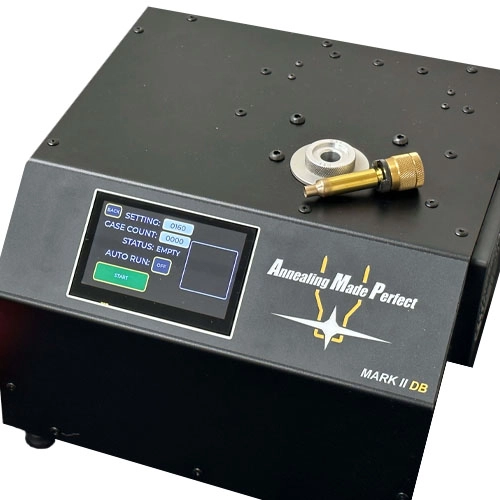
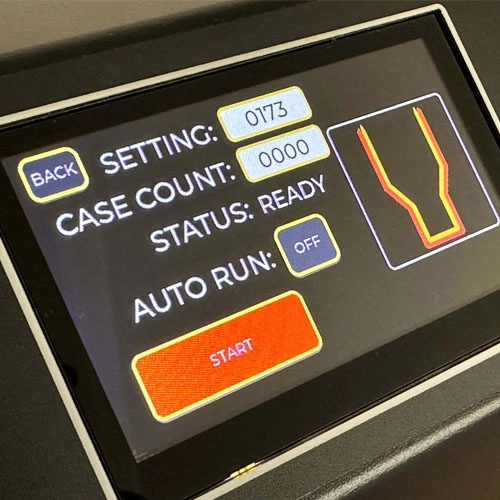
The current model is the Mark II DB, and DB stands for Database. You can name and store AZTEC codes, so the next time you load that cartridge or lot the code is already there. AMP launched the DB in 2024. Compared with the earlier Mark II it gained a touchscreen in place of buttons and an LCD, a faster processor, a USB-C port and additional internal shielding.
The touchscreen is user-replaceable. A small detail that says a lot about how long AMP expects these machines to stay on benches.
Universal power input from 85 to 265 V, so it runs on 230 V without an adapter
Rated at 750 W, actually draws under 600 W, less than a small microwave
Custom ferrite core with an air gap, air cooled with fans that speed up as the unit warms
Fully shielded housing, passes international EMC/FCC and electrical safety standards
Cartridges from .17 Hornet up to .50 BMG, with the .50 BMG settings working on the Mark II only
29 x 28 x 20 cm (11.5 x 11 x 8 in)
AZTEC built in as standard
Every time you press start, the machine runs a diagnostic lasting milliseconds and compensates for its own temperature. The idea is that a warm machine at the end of a session delivers the same anneal as a cold one at the start. A gas flame cannot promise that, it shifts with bottle pressure, ambient temperature and even a draught in the workshop.
AZTEC: a setting derived from a sacrificial case
The original AMP ran fixed programs. AMP published the list, and if your brass was not on it you posted a few cases to New Zealand for free calibration. That list still exists as Standard mode. Since the Mark II, though, AZTEC is the default way of working.
What happens during an analysis
AZTEC is not a built-in hardness tester. It reads the electrical response of the case while it heats. The patent describes an embodiment that shows the principle well. The neck sits in the air gap of the ferrite core, and the inductor forms part of an electrical resonant circuit. The brass in the gap affects how that circuit responds.
The sacrificial case is heated in bursts of a tenth of a second. After each burst a short pulse goes through the circuit and the resonance is timed, each measurement taking less than 0.2 milliseconds. While the brass is solid, the reading drifts gradually. Once the neck starts to melt, it jumps. That tells the machine how much energy this particular case needed to reach that point.
A patent describes possible implementations, so the exact intervals in a current machine may differ. The principle is the same.
The anneal time is then a fixed ratio of that time to melt. AMP derived the ratio experimentally from hardness testing, aiming for a result within a narrow band around the target hardness. That is why one case is sacrificed. After the analysis it is scrap, and the code it produced is used for the rest of the lot.
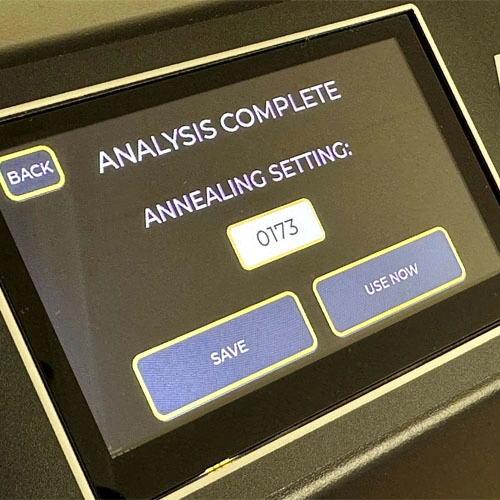
AZTEC in four steps
Look up your pilot number and suffix (the formula) for your case on AMP's AZTEC Settings page
Select ANALYSE and enter that combination
Insert the sacrificial case and press START
Note the code the machine generates, or save it in the DB's database, then start annealing
Picking the sacrificial case
The analysis is only as good as the case you feed it. AMP names neck wall thickness and case weight as the two biggest factors. Check around ten cases with a ball micrometer and pick a representative one. A weight difference above 0.5 grain is potentially significant, and at 2 grains or more the outcome frequently shifts. Use a case that is fired and not yet sized, since sized and unsized cases can return slightly different codes. Clean or dirty makes no difference to the code, and neither does trim length within reason. Round case mouths do matter. An out-of-round mouth gives erratic codes.
With premium brass such as Lapua, Peterson or Alpha, AMP expects codes within plus or minus 1 from case to case. Mixed lots or lesser brass will spread wider. That makes AZTEC a handy quality check on your brass as a side benefit.
Fine adjustment
After the analysis you can shift the code up to six steps either way. Plus adds power for a softer neck, minus does the opposite. AMP calibrated each step at roughly 2.5 HV. Useful if you deliberately want a touch more or less grip, but always start from the code the machine generated.
Standard mode, and why lots differ
Scroll through AMP's settings list and the reason AZTEC exists becomes obvious. The same cartridge from the same maker can need a very different program from one lot to the next. A few examples from the Standard list:
Cartridge | Pilot | Brass | Standard program (neck wall) |
|---|---|---|---|
.223 Rem | 3 | Lapua / Lake City | 47 (0.013") / 28 (0.0115") |
6mm BR | 10 | Lapua / Norma | 72 to 75 (0.013") / 91 (0.0135") |
6mm Creedmoor | 17 | Hornady / Alpha | 52 (0.014") / 70 (0.0155") |
6.5x47 Lapua | 50 | Lapua, lot dependent | 71 or 76 (0.013") |
6.5 Creedmoor | 17 | Hornady / Lapua (small primer), lot dependent | 45 to 53 / 74 to 93 |
.308 Win | 11 | Lapua / Winchester | 93 to 101 (0.015") / 41 (0.0125") |
.300 Win Mag | B29 | Lapua / Norma | 57 (0.0145") / 60 (0.014") |
.338 Lapua Mag | 37 | Lapua / Hornady | 99 / 71 (0.015") |
Extract from AMP's Standard settings list, for illustration. For your own brass, always use the current list or AZTEC.
Look at Lapua 6.5 Creedmoor. Across lots the program runs from 74 to 93, which is not a rounding error. The list also has columns for necks turned 0.001", 0.002" or 0.003" thinner, because a thinner neck needs less energy. Within one brand, AMP finds the relationship between neck wall and program close to linear. If you turn necks, AZTEC is simply the easier route, since you just analyse a sacrificial case from your turned batch.
Choosing the right pilot
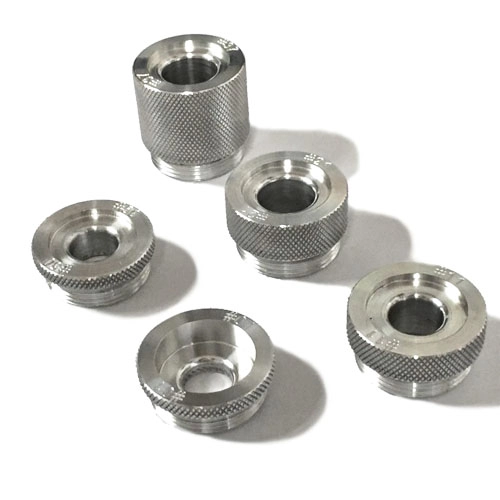
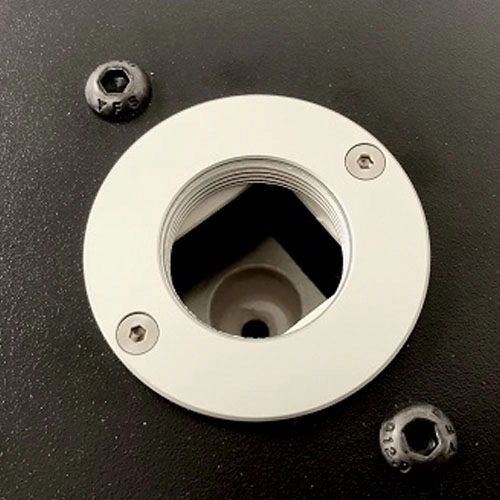
A pilot is an anodised aluminium insert that screws into the holder on top of the machine. The case goes in neck first. The pilot decides how far the neck drops into the air gap, and AMP is emphatic that this is critical. A variation of only a few millimetres makes a measurable difference to the final hardness.
That is why current pilots are depth specific. There is nothing to adjust, you screw them all the way in and they are set. The number follows case length and shoulder position rather than bullet diameter, so families of cartridges often share a pilot.
Pilot | Examples |
|---|---|
3 | .223 Rem and derivatives |
10 | 6mm BR family |
11 | .243 Win, .260 Rem, 7mm-08, .308 Win |
14 | .30-06 family, such as .25-06, .270 Win and .280 Rem |
17 | 6.5 Creedmoor, 6mm Creedmoor |
20 | 6.5 PRC, 7mm SAUM and relatives |
50 | 6.5x47 Lapua, 6XC |
52 | 6mm Dasher |
B29 | .300 Win Mag (B stands for belted) |
37 | .338 Lapua Mag |
A few practical points. Always check the current AMP settings list for your pilot, including wildcats and Ackley Improved variants, since many are listed. In AZTEC you enter three digits, so pilot 11 becomes 011 followed by the letter suffix. And if you run 6BR or 6BRA through the AMP MATE, use pilot 64. The pilots for the AMP annealer are ordered separately, one per pilot number.
The AMP MATE: hands-free annealing
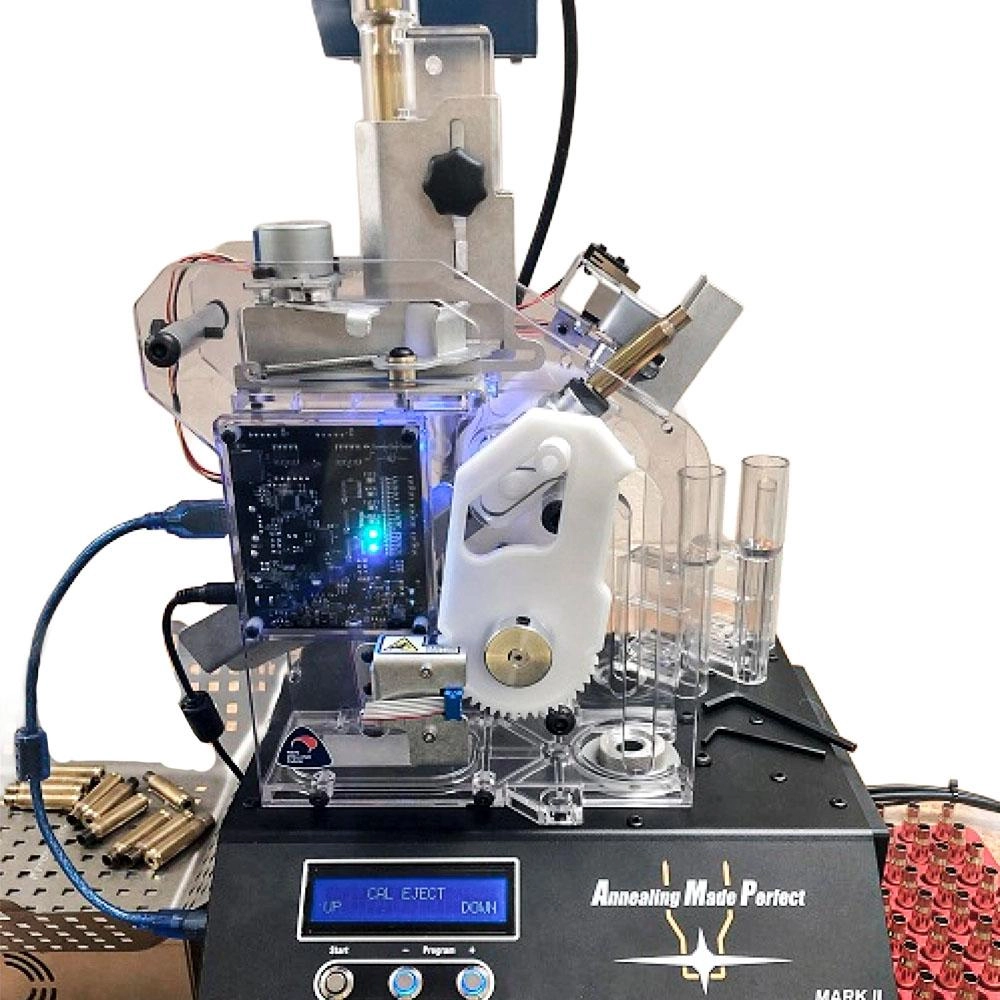
The Mark II was designed to be fed by hand, one case at a time. Case in, start, case out. Pleasant enough, until you have a few hundred cases to get through. That is what the AMP MATE is for.
The MATE sits on top of the annealer and connects over USB. A servo arm takes the case in a shell holder, tips it into the pilot, waits for the anneal cycle to finish and ejects it. You feed the MATE from a Dillon or Hornady case feeder on a suitable stand, neither of which is included. When it runs out of cases it stops and chimes.
Works with both the Mark I and the Mark II
Handles cases from .300 Blackout (shortest) to .338 Lapua Mag (longest and widest)
AMP recommends Redding EZ Feed shell holders, whose flat base stops cases tipping forward
USB port for software updates, parts are user accessible
AMP reports its in-house units running hundreds of thousands of cycles without replacement parts
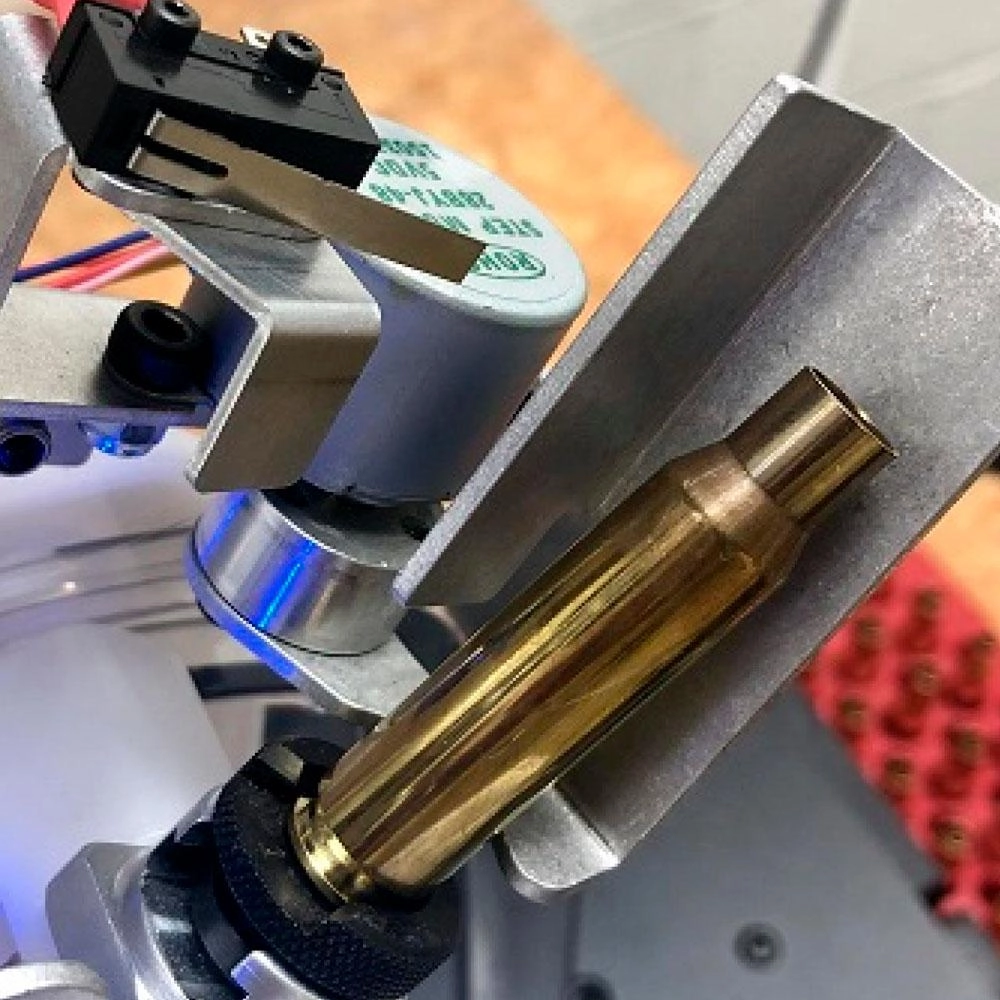
Today's MATE is a revised version. AMP reworked the mechanics and electronics to prevent jams, while the principle stayed the same.
After annealing: measuring and analysing seating force
Annealing feels like an improvement. But what does it actually do to bullet grip, and how would you see it? Neck tension cannot be measured directly. What you can measure is neck dimensions and the force needed to seat the bullet. AMP did exactly that in part 4 of its research series, using Peterson .308 Win brass, a bushing die, a Forster Co-Ax press and a seating press fitted with a load cell. Five reload cycles, annealed and unannealed, with and without an expander.
What the measurements showed
Be clear about what was measured. The inch figures below are outside diameters of the sized case neck. AMP derived the interference on the bullet from those, using the other dimensions in this specific test. And interference is a difference in size, not a force.
Unannealed, without an expander, the sized neck measured 0.335" outside diameter after the first cycle, which AMP put at 0.002" of diametral interference on the bullet. By the fifth firing, spring-back had grown that diameter to 0.3364", leaving only 0.0006" of interference. Measured seating force fell with it.
Adding an expander helped, but not much. Interference dropped from 0.002" to 0.0012" by the fifth firing. The neck gets worked twice per sizing stroke, once by the bushing and again by the expander, and hardens faster as a result.
Annealed before every sizing, the sized neck measured 0.3353" outside diameter on every single cycle. Shoulder bump stayed within 0.0005", and the seating force traces sat much closer together.
One caveat that AMP raises itself. In this test the annealed cases grew more in length, 0.0105" over five firings without an expander against 0.0025" for the unannealed cases. Softer brass flows more readily, so check trim length more often once you start annealing.
The AMP Press makes it visible
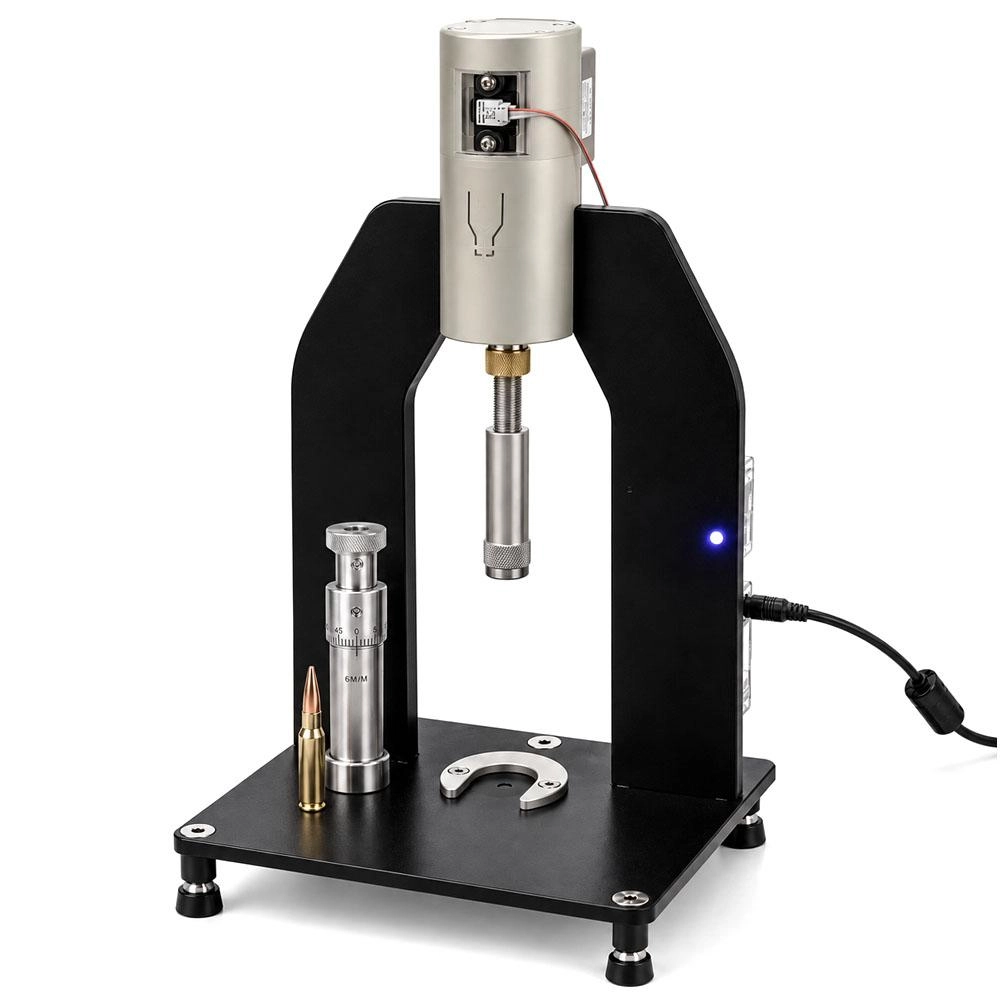
The AMP Press is essentially the instrument from that study, developed into a product. A 12 V motor drives the ram at repeatable speed and force, a load cell reads up to 200 kgf (about 1.96 kN), and a position sensor tracks travel to 0.001". The software plots a force versus distance trace for every round and calculates Total Work Done, the area under the curve. It takes inline seating dies, not standard 7/8-14 threaded dies.
A simple way to run the analysis:
Seat a batch in unannealed cases and save the session
Anneal the next cycle with AZTEC, size with the same die setting and seat again
Overlay the traces. Look at the spread between cases, not just the height
Re-measure sized neck diameter. Softer brass springs back less, so the same bushing can give different interference
Sort by Total Work Done and set the outliers aside, or match them against your chronograph data
Keep in mind what seating force does and does not tell you. Besides interference, friction, the condition of the inside of the neck and seating depth all play a part, as AMP itself points out. A tighter bundle of traces after annealing mainly means your bullet grip has become more consistent. It is not a measurement of absolute neck tension.
How to read such a trace, which shapes point to chamfer, trim length or work hardening, and how the AMP Press compares with an arbor press and force gauge, is covered in our article on neck tension and seating force.
And downrange?
Part 5 of the series went to the range. In an underground 100 yard tunnel, Lou Murdica fired twenty shots through one single case, reloading it between every shot. With a 30 PPC, extreme spread was 77 fps unannealed and 36 fps annealed. With a .308 Win and Lapua brass it was 42 against 35 fps. Peterson brass went the other way, 26 fps unannealed and 29 fps annealed. Yet in all three comparisons, the annealed case shot the smaller group.
Honest data, then, not a miracle. Annealing removes one variable, and the rest of your load and case prep still has to be right.
AMP vs Vulcano vs BurstFire
All three use induction, so no flame. The similarities largely end there. The differences lie in how the field is shaped, who decides the setting, and how cases get in and out.
| AMP Mark II DB | Vulcano (Shooting Technology) | BurstFire 2-in-1 |
|---|---|---|---|
Origin | New Zealand | Italy | US brand |
Field shaping | Gapped ferrite core | Induction zone around the case, geometry not published | Copper coil around the case |
Setting | AZTEC analysis or lab settings | User set, dials for time (max 4 s) and field strength | User set, speed dial |
Case height | Fixed by pilot | Shell holder on spacers, with a printed positioning chart | Manually adjustable |
Basis of the setting | Derived from lab hardness testing | Own calibration with temperature lacquer | Own calibration, lacquer or by eye |
Feeding | By hand, automatic with AMP MATE | By hand | Automatic, gravity chute and wheel |
Cooling | Air | Air, with over-temperature alarm | Closed-loop water cooling |
Mains | 85 to 265 V | 230 V, 1400 W | 110/220 V switchable, US plug |
Extras | Database of saved codes | Freely adjustable parameters | Six case prep stations |
Price at Hop.nl | €2,030.00 | €979.95 | €829.95 |
Prices as of 13 October 2026, excluding pilots, shell holders and any promotions.
Vulcano: every dial is yours
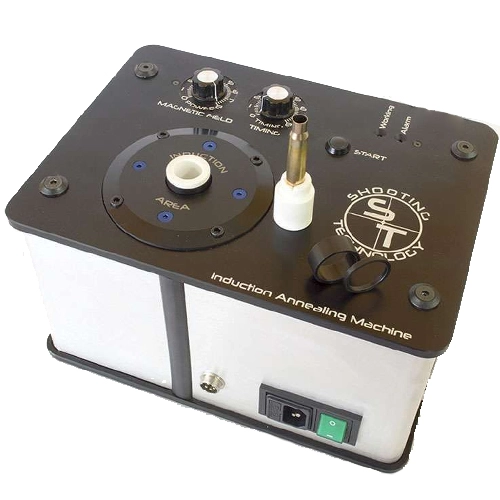
The Vulcano is made by Shooting Technology in Thiene, northern Italy. You set two things independently: time, up to four seconds, and the strength of the magnetic field. The case sits in a shell holder on stackable 2, 6, 10 and 14 mm spacers, and a positioning chart printed at full scale shows you where the neck needs to be.
Shooting Technology sells that freedom as the main advantage, and fairly so. It does mean you are the one doing the calibration. The manual works with temperature lacquer and aims for roughly 380 to 400 °C on the neck. A methodical reloader who sets up one lot at a time can get very consistent brass out of a Vulcano for about half the price of an AMP. There is no auto-feed, it is one case at a time.
BurstFire: speed and automation
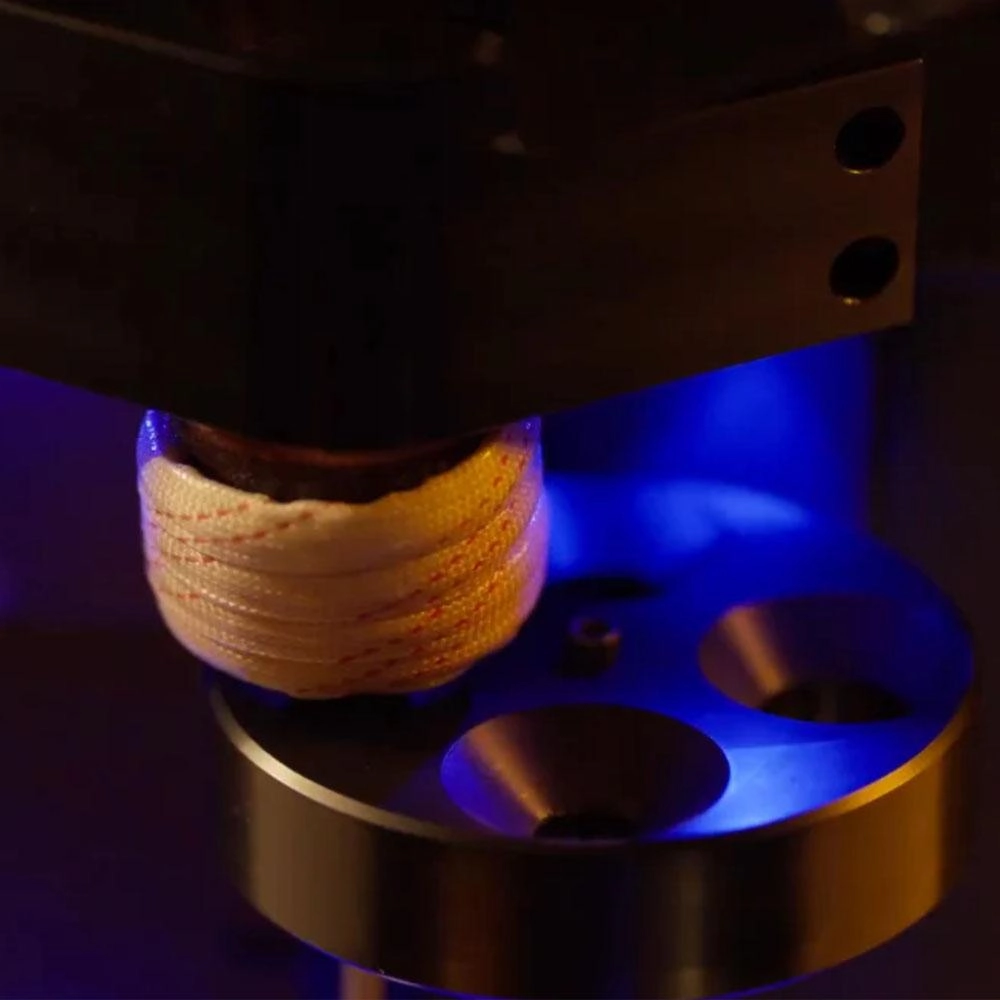
The BurstFire 2-in-1 combines an induction annealer with six motorised case prep stations. Cases roll down a chute to an aluminium wheel that carries them into the coil and releases them. It is quick, owners quote about three seconds per case. The coolant loop keeps the coil in check even on long runs. Note that it ships with a US plug and a voltage selector, so check the switch before you power it up for the first time.
The setting is a number on a speed dial that you find yourself for each brand and lot. Owners also report that the height is hard to repeat after a calibre change unless you mark it. For high volumes of training and hunting brass the BurstFire is very capable. Because you find the setting yourself without a hardness reference, consistency depends more on your own method.
Which one suits you?
If you want an annealer that derives its own setting from a sacrificial case, repeats lot after lot and needs no temperature lacquer, the AMP is the logical choice, especially for F-Class, benchrest, PRS or ELR where you are chasing the last few fps of ES and SD. If you want induction but prefer to turn the dials yourself, the Vulcano gives a lot of control for less money. And if volume and convenience come first, the BurstFire gets through a bucket of brass fastest.
Temperature lacquer, time and temperature
With flame annealers, and with the Vulcano and BurstFire, temperature indicating lacquer such as Tempilaq is the usual way to find a setting. Does it work? Yes, as an aid. But it has limits worth understanding.
Annealing depends on temperature and time together. An old US National Bureau of Standards study found that 70/30 brass only starts to soften after several hours at 325 °C, after half an hour at 375 °C and after ten minutes at 400 °C. AMP held cases in an oven for an hour at 300 to 350 °C and saw hardly any change in the neck. A cycle lasting a few seconds therefore needs a much higher peak temperature than slow heating does. The hotter you go, the shorter the time required.
Temperature lacquer only tells you that a given temperature was reached on the outside of the neck, at the spot where you painted it. It says nothing about how long the brass stayed there and very little about the inside of the wall. Users also report that coating thickness matters and that higher-rated lacquers tend to burn rather than melt. In the AZTEC patent, AMP describes melting-point methods as cumbersome and prone to human error. Our view: lacquer is a fine safety net against overheating, but it is not a hardness gauge.
Fitting the AMP into your reloading sequence
Deprime and clean. If you use stainless pins, anneal after cleaning, because AMP measured an hour of pin tumbling adding about 30 HV to the neck, and four hours about 45 HV
Anneal every reload, on fired cases before sizing
Let the cases air cool. AMP found quenching in water unnecessary, with no metallurgical benefit
Check your sizing die. According to AMP, properly annealed brass has almost no spring-back, so you will likely need to back the die out slightly to keep the same shoulder bump
Re-measure neck diameter and shoulder on the first batch, and check trim length
Where annealing sits in the full process, from depriming through seating, is set out in the correct sequence for reloading precision rifle ammunition. For trimming, chamfering and case measurement, case preparation from decapping to trimming is the natural next read.
Is the AMP worth the money?
The AMP Mark II DB sells for €2,030.00 at Hop.nl, plus €39.95 per pilot. That is more than twice the Vulcano. What the extra buys is certainty. Settings traced back to hardness testing rather than colour or paint, unaffected by your gas bottle or the temperature in your shed, and repeatable for every new lot in a few minutes with AZTEC.
If you load a few hundred hunting rounds a year, it is probably more machine than you need. If you compete at long range, or you plan to make bullet grip measurable with an AMP Press, it is the foundation the rest of your case prep sits on.
Frequently asked questions
What does DB stand for in Mark II DB?
Database. The DB stores named AZTEC codes so you can recall them by cartridge and lot.
Does the AMP run on European mains power?
Yes. The power input is universal from 85 to 265 V, so it plugs straight into 230 V.
Can Mark I owners use AZTEC?
AZTEC is built into every Mark II. On the Mark I it is an optional upgrade, activated with an unlock key from AMP.
Should I quench cases after annealing?
No. AMP tested it and found no metallurgical benefit. Just let them air cool.
How often should I anneal?
AMP recommends every reload, before sizing. Only then does every case start from the same hardness and size the same way each time.
Does AZTEC work with turned necks?
Yes, that is where it shines. The analysis works from the sacrificial case as it is, turned or not, so take it from the same turned batch.
Further reading
Not sure which annealer fits your cartridges and discipline, or which pilot you need? Get in touch, we are happy to help you work it out.
Sources: AMP Annealing, product information for the Mark II DB, AMP MATE, AMP Press and AZTEC, FAQ and the "Annealing under the Microscope" research series (including parts 4 and 5), ampannealing.com. Patents US9631251 B2 and US11209375 B2. AMP News, "Mark II DB" (January 2024). Shooting Technology, Vulcano manual and product information. BurstFire, product information and FAQ. National Bureau of Standards, Technologic Paper T-285 (1924), on the softening of brass. C26000 cartridge brass material data, Copper Development Association. Owner reports via AccurateShooter, Sniper's Hide and Rokslide.